Introduction
Contractors heading into 2026 face a familiar squeeze: tighter project timelines, rising ownership costs, and real pressure to stay lean on every job. Equipment rental has become a core operational strategy for most contractors. The U.S. construction equipment rental market hit an estimated 59.5% penetration rate in 2025 — meaning nearly six out of ten contractors now choose rental over ownership to avoid depreciation, storage headaches, and unplanned maintenance bills.
Renting gives contractors access to job-ready machines without the capital outlay or upkeep costs of ownership. This guide covers the five most in-demand construction equipment rentals in 2026, what to look for in each machine, and how to pick the right rental partner for your job site.
TLDR
- Compact track loaders and mini excavators are the most rented construction equipment categories heading into 2026
- Renting cuts ownership costs and gives contractors access to newer models without long-term capital commitments
- Backhoe loaders, full-size excavators, and bulldozers round out the core fleet for earthmoving, demolition, and grading across most project types
- Choosing a rental provider with experienced operators and in-house delivery reduces coordination headaches on active job sites
Why Contractors Are Renting More Equipment in 2026
The American Rental Association reported that the combined U.S. construction and industrial equipment rental industry finished 2025 as an $80.6 billion industry, with projected growth to $82.9 billion in 2026. A 2025 survey found that 72% of contractors rented equipment in the past 12 months, reflecting how rental has shifted from occasional necessity to standard practice.
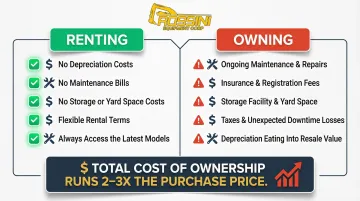
Renting eliminates depreciation, storage costs, and emergency maintenance bills while giving crews access to the latest machine models. Total cost of ownership typically runs 2–3x the original purchase price once you account for:
- Maintenance and repairs
- Insurance and registration
- Storage and yard space
- Taxes and downtime losses
For contractors, that math translates directly to faster project completion, tighter budgets, and less administrative overhead.
Those savings are only part of the shift. The rental market in 2026 now offers daily, weekly, and monthly rates alongside "wet rentals" — equipment delivered with a qualified operator already included. With over 80% of construction firms struggling to find qualified workers, wet rentals eliminate the need to source separate labor for specialized tasks, keeping projects moving without the hiring delays.
Top Construction Equipment Rentals for Contractors in 2026
These five equipment types were selected based on rental demand, project versatility, and the role each plays across excavation, grading, site prep, and demolition work.
Mini Excavators
Mini excavators are consistently the most rented heavy equipment category for contractors. Ideal for confined job sites, residential excavation, trenching, and landscaping work where a full-size machine would be impractical, they typically fall within the 1–6 ton class and offer dig depths ranging from roughly 6 to 14 feet depending on model.
What sets mini excavators apart in 2026: improved hydraulic performance, reduced or zero-tail-swing designs for tight spaces, and the option to add attachments like augers, hydraulic breakers, and buckets that extend their usefulness across multiple project phases.
Rental rates for mini excavators typically range from $225 to $575 per day and $700 to $1,550 per week, depending on size class.
| Criteria | Details |
|---|---|
| Best For | Trenching, landscaping, utility work, residential excavation, tight access sites |
| Typical Specs to Know | Operating weight 1–6 tons; dig depth typically 6–14 ft depending on model class |
| Rental Considerations | Available daily, weekly, or monthly; confirm whether an experienced operator is included or self-operated; verify attachment compatibility before booking |
Rossini Equipment Corp. offers mini excavators including a brand-new 1-ton model designed for small-scale projects and tight spaces, plus a CAT 308E2 CR 9-ton compact excavator with a 13-foot 6-inch dig depth. Equipment can be rented with or without an experienced operator, providing flexibility for contractors who need skilled labor or prefer to operate machines themselves.
Full-Size Excavators
Full-size excavators (typically 10–40+ ton class) are the primary machine for large-scale excavation, foundation digging, land clearing, and demolition projects. These machines deliver the reach, breakout force, and bucket capacity needed on commercial builds, utility infrastructure work, and road construction.
Mid-size excavators typically reach depths of around 21 feet, while large 30-40 ton machines push past 26 feet with bucket capacities exceeding 2.5 cubic yards. In 2026, contractors renting full-size excavators increasingly look for machines with telematics capability for jobsite tracking. United Rentals reported having over 375,000 telematics-enabled units in 2024, allowing remote tracking of utilization, emissions, and maintenance needs.
Rental providers who can supply an experienced operator are particularly valuable on projects requiring precision grading or working around existing utilities. Rossini Equipment Corp. stands out here: equipment can be rented with or without a skilled operator, backed by decades of excavation experience serving clients including the Port Authority of New York and New Jersey and Con Edison.
Rental rates for full-size excavators vary significantly by size. A 25,000–29,000 lb excavator typically costs around $520 per day or $1,664 per week, while a 40,000–44,000 lb machine averages $623 per day or $2,039 per week.
| Criteria | Details |
|---|---|
| Best For | Foundation excavation, large-scale site clearing, demolition, utility trenching, infrastructure projects |
| Typical Specs to Know | Operating weight 10–45+ tons; dig depth 15–25+ ft; bucket capacity typically 0.9–2.6 yd³ for mid-to-large class models |
| Rental Considerations | Higher-value machine—confirm daily/weekly/monthly rates with provider; factor in delivery/haul costs; verify whether operator is included in the rate |
Compact Track Loaders
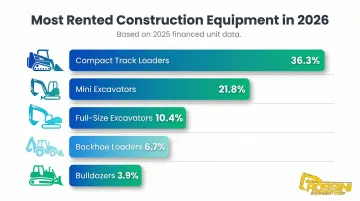
Compact track loaders (CTLs) are the single most financed and most sold construction equipment category in the U.S., accounting for 36.3% of all new financed units in 2025. That same demand drives rental volumes. Their tracked undercarriage exerts just 4 to 6 PSI of ground pressure — compared to 30 to 45 PSI for wheeled skid steers — allowing them to work on wet, muddy, or sandy terrain without tearing up the surface. Attachment versatility (buckets, forks, grapples, augers, planers) extends their usefulness across multiple project phases.
For Sullivan County and Hudson Valley contractors dealing with variable terrain, CTLs are a frequent first choice. Standard rental CTLs weigh between 8,000 and 11,000 lbs, with rated operating capacities between 2,100 and 3,400 lbs.
| Criteria | Details |
|---|---|
| Best For | Site prep, grading, material handling, landscaping, demolition cleanup, working on wet or soft ground |
| Typical Specs to Know | Operating weight typically 8,000–12,000 lbs; rated operating capacity 1,200–3,500 lbs; track width affects ground pressure (typically 12–18 inches) |
| Rental Considerations | Available in a range of size classes; verify track condition before use; daily/weekly/monthly rental rates vary by size—ask provider about attachment availability |
Backhoe Loaders
Backhoe loaders are one of the most versatile machines on any job site, combining a front loader bucket with a rear excavating arm in a single unit. Ideal for contractors who need multi-task capability without renting separate machines: dig a trench, load material, and grade a surface with one piece of equipment.
They remain a staple rental for mid-size contractors, landscapers, and municipal crews in 2026 — particularly for utility work, drainage installation, and mixed excavation/loading tasks. The 14-foot dig depth class is the industry standard, typically paired with 1.0 to 1.4 cubic yard loader buckets and 74 to 113 horsepower across common rental models.
| Criteria | Details |
|---|---|
| Best For | Utility trenching, drainage work, foundation prep, mixed excavation and loading tasks, site cleanup |
| Typical Specs to Know | Dig depth typically 14–18 ft; loader capacity 1.0–1.4 yd³; horsepower ranges from 74–113 hp for common rental classes |
| Rental Considerations | Versatile machine that can reduce need for multiple equipment rentals; confirm loader and backhoe attachment specs match your project scope |
Bulldozers
Bulldozers are the standard choice for heavy land clearing, rough grading, large-scale earthmoving, and site preparation where significant material needs to be pushed or spread. Crawler-type dozers perform well on rough terrain and steep grades, making them essential for developers, road contractors, and site work crews.
Key selection factors when renting a bulldozer in 2026:
- Blade type: straight, angle, or U-blade depending on clearing vs. grading needs
- Undercarriage condition: worn tracks directly affect productivity and grade accuracy
- Horsepower class: matched to your project's volume and material type
- Operator experience: precision cut/fill work demands a skilled hand — ask whether operator-included rental is available
Low Ground Pressure (LGP) configurations increase track shoe width — from 24 to 36 inches on a Cat D6, for example — reducing ground pressure on soft or prepared surfaces. Medium dozers deliver 112–215 horsepower with blade capacities of 3.75 to 5.8 cubic yards; large dozers can exceed 350 horsepower with blade capacities up to 15.6 cubic yards.
| Criteria | Details |
|---|---|
| Best For | Land clearing, rough grading, large earthmoving, cut and fill work, site preparation for new construction |
| Typical Specs to Know | Horsepower ranges: small/medium 112–215 hp, large 300+ hp; blade capacity 3.75–15.6 yd³; track shoe width 22–36 inches (LGP variants wider) |
| Rental Considerations | Typically rented weekly or monthly for larger site prep projects; operator skill level significantly impacts productivity—ask provider about operator-included options |
How We Selected the Top Equipment for This List
These five equipment types were identified based on national rental demand data, construction project frequency across excavation, grading, site prep, and demolition categories, and what contractors in the Northeast—particularly Sullivan County and the Hudson Valley—commonly need across residential, commercial, and infrastructure projects.
Common contractor mistakes when selecting rental equipment:
- Choosing the wrong size class — an underpowered unit causes delays, while oversized equipment wastes fuel and damages sensitive surfaces
- Skipping hydraulic compatibility checks — mismatched GPM and pressure ratings between the carrier and attachment cause failures or poor output
- Ignoring logistics details — unplanned transportation surcharges, site access constraints, and delivery timing lead to idle equipment and blown budgets
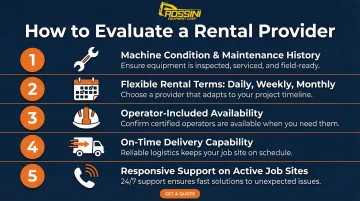
Practical evaluation factors for any rental decision:
- Machine condition and maintenance history
- Flexibility of rental terms (daily/weekly/monthly)
- Whether an operator can be included
- Provider's ability to deliver on time
- Responsiveness when equipment issues arise on an active job site
Industry consensus relies on the "60% Rule": if a piece of equipment is utilized less than 60% to 70% of the time, renting is the more economical approach. Once utilization consistently clears that threshold, the purchase price, depreciation, and upkeep costs start to make ownership viable — but for most contractors running varied project types, rentals remain the sharper financial move.
Conclusion
For contractors in 2026, equipment rental is about flexibility—having access to the right machine, at the right time, without the overhead of ownership. The five equipment types covered here cover the majority of earthmoving, site prep, and excavation needs a contractor will encounter.
Assess not just the machine but the rental partner. Equipment that shows up ready to work, backed by knowledgeable support, is what keeps projects on schedule and within budget.
Rossini Equipment Corp. has been that kind of partner for contractors across Sullivan County, Orange County, and the Hudson Valley for over 25 years. With flexible daily, weekly, and monthly rates, in-house delivery and pickup, and equipment available with or without an operator, Rossini keeps projects moving. Call (845) 794-1066 or email office@rossiniequipmentcorp.com to discuss your next project.
Frequently Asked Questions
What is the average daily cost to rent an excavator?
Rental rates vary by machine size and duration. Mini excavators (4,000–6,000 lb) typically cost $197–$316 per day, mid-size excavators (25,000–29,000 lb) average around $520 per day, and large excavators (40,000–44,000 lb) run approximately $623 per day. Adding an operator for a "wet" rental significantly increases daily costs.
What construction equipment is most commonly rented?
Compact track loaders are the #1 most financed and rented equipment category, representing 36.3% of the market, followed by mini excavators at 21.8% and full-size excavators at 10.4%. That spread reflects how often contractors need compact, multi-purpose machines across both residential and commercial sites.
Is it better to rent or buy construction equipment for a short-term project?
Renting is typically more cost-effective for projects where equipment utilization falls below 60% of available working days. It eliminates maintenance, storage, and depreciation costs — a clear advantage for short-to-mid-term work.
What is the difference between renting equipment with and without an operator?
"Wet rental" includes a skilled operator in the rate — useful for precision work like grading, utility excavation, or demolition where experience matters. "Dry rental" provides the machine only; the contractor supplies their own trained operator.
What size excavator do I need for my project?
Mini excavators (1–6 ton) work for residential, landscaping, and confined sites. Mid-size excavators (7–15 ton) suit commercial foundations and utility work. Large excavators (20+ ton) are needed for major earthmoving and demolition projects requiring deep dig depths and high bucket capacity.
How far in advance should I book heavy equipment rentals?
Book at least 2–4 weeks out during peak construction season — earlier if your project falls between April and October. At booking, confirm delivery logistics, site access, and rental terms (including extension options) to avoid last-minute delays.