This guide breaks down what you'll actually pay, what drives those costs, and how to budget smarter so your next move doesn't blow your project budget.
TL;DR
- Local hauls of small equipment typically cost $200–$500; oversized, long-distance moves requiring permits and escorts can exceed $10,000
- Equipment weight, dimensions, distance, and permit requirements are the biggest cost drivers
- Per-mile rates drop as distance increases—short hauls cost more per mile because fixed costs spread over fewer miles
- Renting from a company with an in-house delivery team simplifies logistics and cuts down on coordination delays
How Much Does Heavy Machinery Transport Cost?
There's no single price tag for moving heavy equipment. Costs vary widely based on machine size, distance, trailer type, and regulatory requirements. Misunderstanding this pricing structure leads to underbudgeting or choosing the wrong carrier, either of which can derail a project.
Short Hauls (Under 100 Miles)
Short-distance moves are typically priced as flat fees rather than per-mile rates because fixed costs—driver time, mobilization, and loading—don't scale down with distance.
Verified 2025 cost ranges for local hauls:
- Small equipment (mini excavators, skid steers): $200–$500
- Large machines (bulldozers, backhoes): $500–$1,500
These base quotes typically include standard transport and basic loading/unloading if the equipment is operational (drive-on). They exclude oversized permits, pilot cars, route surveys, crane loading for non-running machines, and fuel surcharges.
Short hauls carry a higher effective per-mile rate because fixed costs like driver wages and truck positioning are spread over fewer miles than on longer runs.
Medium and Long-Distance Hauls
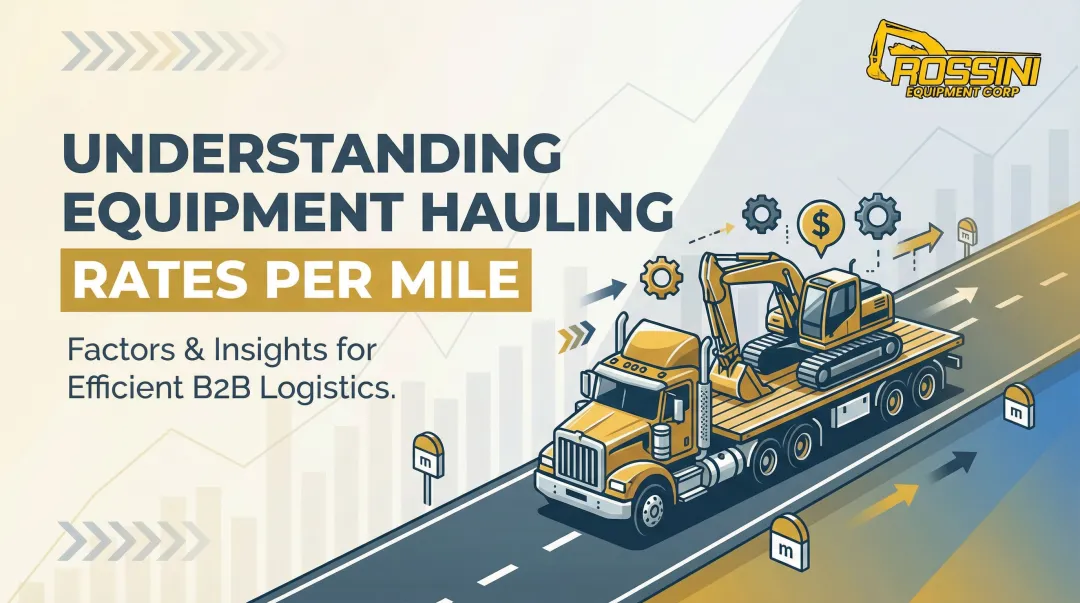
As distance increases, per-mile rates decline—but total cost rises. Industry data shows that per-mile pricing follows a predictable curve:
| Distance Band | Cost Per Mile |
|---|---|
| 0–200 miles | $4.00–$5.00 |
| 200–500 miles | $3.50–$4.00 |
| 500–1,000 miles | $3.00–$3.50 |
| 1,000–1,500 miles | $2.50–$3.00 |
| 1,500+ miles | $1.00–$2.50 |
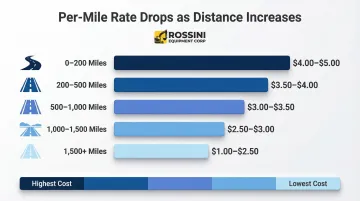
A 150-mile move might cost $750 at $5.00/mile, while a 1,200-mile haul might run $3,600 at $3.00/mile—lower per-mile rate, higher total bill.
Oversized and Complex Loads
Distance-based pricing only tells part of the story. When equipment exceeds standard legal limits—8'6" width, 13'6" height, or 80,000 lbs gross weight in New York State—transport costs climb sharply. Oversized loads trigger:
- Permits: $100–$400 per state crossed
- Pilot/escort vehicles: $1.50–$2.00 per mile, per car
- Police escorts: $75–$150 per hour (for superloads)
- Route surveys: $500–$2,000 for complex moves
Total costs for oversized, multi-state moves can easily reach $10,000 or more, especially when multiple escorts and permits are required.
Transport Cost by Trailer Type
Trailer selection is dictated by equipment dimensions, weight, and loading method. Each trailer type carries different per-mile rates:
| Trailer Type | Per-Mile Rate | Best For |
|---|---|---|
| Hot Shot | $1.50–$2.50 | Light equipment, small attachments |
| Flatbed | $2.85–$3.75 | Mini excavators, skid steers (requires ramps) |
| Step-Deck | $2.35–$3.30 | Medium equipment, tall tractors |
| Lowboy/RGN | $3.50–$8.00+ | Large excavators, bulldozers, heavy cranes |
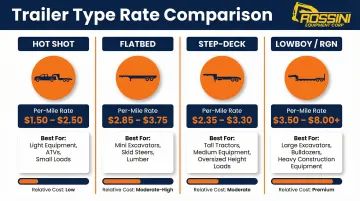
Lowboy and RGN (Removable Gooseneck) trailers cost more but offer drive-on capability and lower deck height, making them essential for heavy, oversized machines.
Key Factors That Affect Heavy Equipment Transport Costs
Transport quotes vary widely — and the gap between a $1,200 move and a $4,500 move often comes down to a handful of specific variables. Knowing what drives the price means fewer surprises when the quote lands in your inbox.
Equipment Weight and Dimensions
Weight, height, width, and length determine trailer type and whether permits are required. Heavier or taller equipment requires specialized trailers and handling—both of which increase cost.
Federal standards set the baseline: 80,000 lbs gross vehicle weight, 102" width on the National Network, and state-specific height limits (typically 13'6" to 14'6"). Exceed those thresholds, and you're into permit territory.
Distance and Route Complexity
Total mileage sets the floor on cost, but the route itself determines how far above that floor you end up. Narrow roads, low bridges, weight-restricted routes, and remote delivery locations require detours or advance planning that add expense.
Urban routes—especially in the New York metro—often involve more restrictions and pilot car requirements than rural routes. A move through Sullivan County back roads is simpler than navigating Middletown or Port Jervis with a 14-foot-tall excavator.
Permits, Escorts, and State Regulations
Each state sets its own thresholds for oversized or overweight loads, and each state crossed requires its own permit. New York State regulations are specific:
- Width: 96" on standard highways; 102" on qualifying highways
- Height: 13'6"
- Length: 40' (single vehicle); 65' (combination)
- Gross Weight: 80,000 lbs
NYSDOT single-trip permits cost $40, but the NY Thruway and NY Bridge Authorities require separate permits and fees. Escort requirements apply for loads over 12' wide, 80' long, or 14' tall, and travel is restricted to daylight hours, Monday through Friday.
Crossing multiple states? Each requires its own permit, and costs stack quickly.
Fuel Surcharges and Seasonality
Most carriers apply a fuel surcharge tied to the U.S. Department of Energy's weekly National Average On-Highway Diesel Price. Surcharges fluctuate weekly and are typically structured as:
- A percentage of the base rate (commonly 13%–30%+)
- A flat per-mile addition ($0.25–$0.50+)
Transport costs also rise during peak construction season (spring and summer) and winter weather periods, when higher demand and operational risk push rates up.
Loading, Unloading, and Accessibility
If specialized loading equipment—cranes, forklifts, ramps—is needed at pickup or delivery, those costs are often added to the quote. Site accessibility matters too: soft ground, tight clearance, steep grades, or limited turnaround space can require additional equipment or labor.
What's Included in a Heavy Equipment Transport Quote
The total cost of moving heavy machinery goes well beyond a base per-mile rate. A complete, itemized quote should account for all of the following.
Base Linehaul Rate
This is the core mileage-based charge—the rate per mile multiplied by distance. It's the starting point for every quote. Moves under 300 miles often use a flat "day rate" rather than a per-mile figure because fixed costs dominate on short hauls.
Fuel Surcharge and Insurance
Fuel surcharges are added on top of linehaul and adjust with diesel prices. Insurance is also a line item that protects equipment during transit. High-value machinery may require higher cargo coverage limits, which increase the premium.
Permits, Escorts, and Special Requirements
Oversize or overweight loads require state-specific permits (fees vary by state), and certain dimensions trigger mandatory pilot or escort vehicles. These are recurring costs per trip and per state. For extremely complex moves—narrow roads, low clearances, or multi-jurisdictional coordination—route surveys may also be required, adding $500–$2,000 to the total.
Hidden Costs to Watch For
Costs often missed in initial quotes include:
- Storage or layover fees if equipment can't be loaded/unloaded on schedule
- Last-minute change fees for rescheduling or route changes
- Tolls and bridge fees on certain routes
- Crane or forklift rental for loading assistance
If a quote doesn't break these out as separate line items, ask for them explicitly before signing—vague "all-in" pricing is where unexpected charges tend to hide.
How to Budget Smarter and Reduce Transport Costs
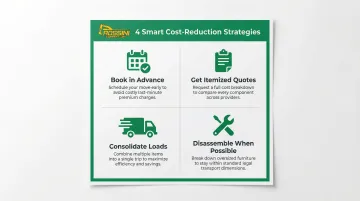
Budgeting accurately means accounting for all cost components before committing. A few proactive steps can meaningfully reduce what you pay:
- Book as far in advance as possible to avoid last-minute premiums and limited trailer availability
- Get multiple itemized quotes (not just headline rates) so you can compare apples to apples
- Consolidate moves by transporting multiple pieces of equipment in one trip
- Ask whether equipment can be partially disassembled to bring it within standard legal dimensions, avoiding permit and escort costs
For contractors and property owners in Sullivan County, Orange County, and the Hudson Valley, Rossini Equipment Corp. runs its own in-house transportation team for delivery and pickup, so there's no separate hauler to coordinate. That means simpler scheduling, fewer moving parts, and more predictable transport costs from the start.
What Most People Get Wrong About Heavy Equipment Transport Costs
The per-mile rate is just the starting point. It doesn't include permits, escorts, fuel surcharges, or loading assistance. The final bill can run hundreds of dollars above what the base quote shows.
Dimensions matter more than most people expect. A machine that's slightly over standard height or width thresholds can trigger permit requirements, escort vehicles, and restricted travel windows — adding hundreds or thousands of dollars before a single mile is driven.
Transport planned at the last minute creates real risk. Skipping verification of carrier credentials, insurance, and permit experience can lead to compliance failures, equipment damage, or project delays. Budget for transport early — not after everything else is locked in.
Frequently Asked Questions
How much does it cost to move heavy equipment?
Typical costs range from a few hundred dollars for short local hauls of small equipment to $5,000–$10,000+ for long-distance or oversized moves. The exact figure depends on equipment size, distance, trailer type, and permit requirements.
How much does it cost per mile to move heavy equipment?
Per-mile rates generally range from $2.00 to $5.00 depending on distance band and trailer type. Short hauls cost more per mile than long-distance moves because fixed costs are spread over fewer miles.
What information do I need to get an accurate transport quote?
You'll need:
- Equipment make, model, and year
- Actual dimensions (length, width, height, weight)
- Pickup and delivery locations
- Any known site access constraints
Do I need permits to transport heavy equipment in New York?
New York State requires permits for loads exceeding standard size and weight thresholds (8'6" width, 13'6" height, 80,000 lbs). Routes crossing multiple jurisdictions require separate permits per state. A qualified hauler handles permit pulling as part of the service.
What is the cheapest way to transport heavy equipment?
Planning ahead, choosing the right trailer size (avoiding over-speccing), consolidating loads, and using a carrier with local knowledge of the route are the most effective ways to reduce costs without sacrificing safety or compliance.
How much does it cost to transport an excavator?
A small excavator moved locally typically costs $300–$800. Larger excavators requiring lowboy trailers and permits for long-distance, cross-state moves can run $3,000–$6,000 or more, depending on distance and complexity.