Introduction
Heavy equipment doesn't just cost money when it's working — idle machines sitting on an unsecured jobsite or an unprotected lot are a financial liability. Theft, vandalism, weather damage, and liability exposure add up quickly when equipment sits unguarded. As construction activity across the Northeast continues to surge — with nonresidential planning up 37% in 2025 according to the Dodge Momentum Index — demand for secure equipment storage has grown alongside it.
Storage rates vary significantly based on equipment type, storage format, contract duration, and location. A compact skid steer stored outdoors month-to-month won't cost the same as a 30-ton excavator in an enclosed bay on a six-month agreement.
What follows covers every price tier, the key cost drivers, and practical budgeting guidance for equipment storage in Sullivan County and the Hudson Valley.
TL;DR
- Monthly heavy equipment storage rates typically range from $70 to $250+ per machine depending on size and storage type
- The biggest pricing drivers are equipment footprint, storage format (outdoor vs. covered vs. enclosed), contract length, and location
- Outdoor storage costs the least; enclosed or climate-controlled storage can cost more than double
- Longer-term storage agreements typically carry lower monthly rates than short-term or month-to-month arrangements
- Skipping proper storage is rarely the cheaper choice: equipment theft alone costs the industry $300 million to $1 billion annually
How Much Does Heavy Equipment Storage Cost?
Heavy equipment storage does not have a fixed, universal rate. Pricing is set by individual facilities and varies widely based on machine size, storage type, and contract terms. Misunderstanding this often leads contractors to underbudget or get stuck in mismatched agreements that don't fit their operational needs.
Typical Monthly Storage Rate Ranges
Storage costs scale with equipment size and format. Here's what the market typically looks like:
Light/Compact Equipment (skid steers, mini excavators, small attachments):
- Outdoor/unsecured: $70–$150/month
- Fenced yard: $100–$200/month
- Enclosed bay: $150–$250/month
Mid-Range Machines (standard excavators, wheel loaders, backhoes):
- Outdoor/unsecured: $150–$300/month
- Fenced yard: $200–$400/month
- Enclosed bay: $300–$500/month
Large/Oversized Equipment (cranes, large dozers, articulated dump trucks):
- Outdoor/unsecured: $300–$600/month
- Fenced yard: $400–$800/month
- Enclosed bay: $600–$1,200/month
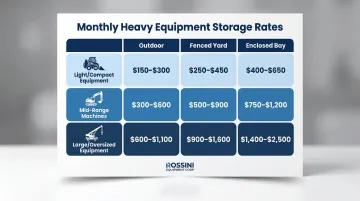
These ranges reflect real-world pricing from facilities across New York State. A 12'x48' outdoor space for tractors and paving equipment in New York runs $70 per month, while an enclosed, weather-protected unit with 9' wide doors costs $150 per month. Rates in rural or semi-rural markets like Sullivan County and the Hudson Valley tend to run lower than urban metro areas, where land costs drive premiums.
Short-Term vs. Long-Term Storage Rates
Pricing structures vary by facility, but the pattern holds across markets: monthly or seasonal agreements cost less per day than rolling short-term arrangements. A contractor storing equipment for three months on a month-to-month basis will pay more than one who locks in a three-month agreement upfront.
Fleet storage adds another lever. Most facilities will discount per-unit rates when you're storing multiple machines — negotiate this before signing, not after. Key situations where it's worth asking:
- Storing equipment between back-to-back jobs
- Parking a fleet through an off-season
- Consolidating machines from multiple sites into one yard
Key Factors That Affect Heavy Equipment Storage Rates
Storage rates are shaped by equipment-specific, facility-specific, and operational variables. Knowing which variables apply to your situation is the fastest way to avoid budget surprises.
Equipment Size and Footprint
Storage is typically priced per machine or per square foot of occupied space. A compact track loader takes up a fraction of the footprint of a 30-ton excavator, which directly affects the rate. Facilities calculate space based on the equipment's length, width, and turning radius — not just the machine itself.
Oversized or irregularly shaped equipment (long booms, wide attachments left on) may incur surcharges or require specialized placement within the yard. If your excavator has a 20-foot boom that extends beyond standard parking lanes, expect to pay more.
Storage Format and Facility Features
Not all storage is equal. The three main formats are:
- Unsecured/open lots: Basic parking on gravel or paved surface, minimal oversight
- Fenced and monitored outdoor yards: Perimeter fencing, surveillance cameras, gated access
- Covered storage: Roofed but open-sided, protects against precipitation
- Fully enclosed bays: Indoor, climate-controlled, highest security
Each step up in protection adds to the rate. Features that justify higher pricing include:
- Perimeter fencing and locked gates
- 24/7 surveillance cameras
- On-site management or security patrols
- Motion-sensor lighting
- Access control systems (keycard, PIN code)
These features reduce theft and vandalism risk directly. Annual equipment theft losses run $300 million to $1 billion industry-wide — the premium for a secured yard is cheap insurance when a single machine theft can exceed $100,000.
Duration and Contract Type
Month-to-month storage costs more per month than a 3-, 6-, or 12-month agreement. For contractors with predictable seasonal downtime or off-season storage needs, a longer commitment usually provides better value. Facilities prefer long-term tenants because it reduces turnover and administrative overhead, so they pass savings along.
The Port Authority of New York and New Jersey illustrates how steeply short-term rates climb: open area storage runs $0.26/SF for 10 days or less (minimum $1,651.49), while covered storage jumps to $0.50/SF with a $2,991.65 minimum. Commit to a longer term and those numbers drop considerably.
Location and Market
Facilities in high-density urban markets charge more due to land costs. Industrial warehouse and storage lease rates in the NYC metro area range from $12–$28 per square foot annually. Outer borough locations (North Brooklyn, Central Queens) command premiums of $18–$28/SF, while peripheral submarkets like Westchester and the Hudson Valley offer lower rates from $12–$16/SF.
Those rate differences trace back to land acquisition costs, which vary sharply by location:
- Rural: $20,000–$50,000 per acre
- Suburban: $50,000–$80,000 per acre
- Urban infill: $80,000–$100,000+ per acre
Those land costs flow directly into what facilities charge tenants — which is why Sullivan County and Hudson Valley yards consistently offer more competitive rates than metro-area operations.
What's Included (and What's Not) in Storage Fees
Storage quotes can look similar on paper but differ significantly in what they cover. Ask for a clear breakdown before signing anything.
Typically Included:
- Use of the lot or bay
- Basic perimeter security (fencing, lighting)
- Access during business hours
- Parking space assignment
Typically NOT Included:
- Liability insurance for stored equipment (your responsibility)
- After-hours access
- Wash-down or cleaning services
- Fueling or fluid top-offs
- Minor maintenance or equipment checks
Some facilities — particularly those operated by equipment dealers or rental yards — may offer extras like pre-storage equipment checks or on-site mechanic access, worth factoring into your total cost. Rossini Equipment Corp's yard in Monticello, NY, for example, has operated since 1998 as part of a construction family with roots going back to 1963. Contractors storing equipment there get proximity to working technicians and maintenance support — not just a parking spot.
Outdoor vs. Covered vs. Enclosed Storage: What's the Price Difference?
The right choice depends on the equipment type, storage duration, and climate exposure risks.
| Storage Type | Best For | Typical Monthly Cost (NY) |
|---|---|---|
| Outdoor (open/fenced yard) | Rugged machines; short-to-medium storage windows | ~$70 for a 12'x48' space |
| Covered (roofed, open-sided) | Equipment with sensitive cabs or electronics; longer periods where UV and rain add up | $100–$150 for compact equipment (50–75% premium) |
| Enclosed/Indoor | Machines with sensitive hydraulics, electronics, or paint finishes; winter storage | ~$150+ for compact equipment, steeply higher for full-size machines (100–150% premium) |
Upgrading from outdoor to enclosed storage represents roughly a 114% price premium. For most rugged, short-term situations outdoor storage works fine — but if you're parking through a New York winter, the math shifts quickly.
Winter Storage Considerations
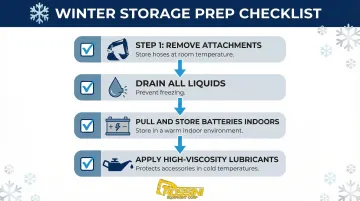
Caterpillar recommends a specific prep routine before leaving equipment in cold storage:
- Remove attachments and store them at room temperature to protect hoses and connections
- Drain all liquids, including fuel, to prevent freezing
- Pull batteries and store them indoors
- Apply high-viscosity lubricants to accessories so they stay in place through the cold
Don't skip the salt and de-icing chemicals either. Even faint surface rust on hydraulic cylinders creates enough pitting to cause cylinder seals to leak on startup.
How to Estimate the Right Storage Budget for Your Equipment
Budget fit matters more than finding the lowest rate. The wrong storage choice can lead to equipment damage, theft losses, or operational delays that cost far more than a few dollars saved per month.
Key Questions to Answer Before Committing:
- How long will the equipment be stored? (Days, weeks, months, or seasonally?)
- What's the replacement or repair cost if something happens to it?
- Does the site need after-hours retrieval?
- Is this between-job storage or seasonal off-site storage?
- Does the equipment have sensitive components that require climate control?
Once you've worked through those questions, sizing the budget is straightforward. The Federal Highway Administration classifies storage as a direct equipment overhead cost — alongside insurance, property taxes, and licenses (23 CFR 635 A). For most contractors, that translates to roughly 1–3% of annual equipment operating costs: a fixed line item, not an afterthought.
Common Mistakes When Budgeting for Equipment Storage
Ignoring Access Restrictions and Hidden Fees
A cheap lot that's only accessible 9–5 can disrupt a job schedule. If you need to retrieve equipment on a Saturday or after hours, confirm access terms upfront.
Watch out for these common add-on costs:
- After-hours access: $50–$100 per event at many facilities
- Insurance riders: Some yards require separate coverage beyond your standard policy
- Gate fees or admin charges: Billed monthly but easy to miss in initial quotes
Choosing Low Security to Cut Costs
Unsecured or poorly monitored lots look attractive on price — until something goes wrong.
The average cost of a single equipment theft runs approximately $30,000, and only 21% of stolen construction equipment is ever recovered. Thefts spike during long holiday weekends like Labor Day and Memorial Day, when job sites sit unattended for days.
Weather damage compounds the risk. Water damage alone accounts for over 30% of construction-related insurance claims — roughly $16 billion in payouts every year. Severe storms have driven $208 billion in insured losses over the past three years in the U.S.
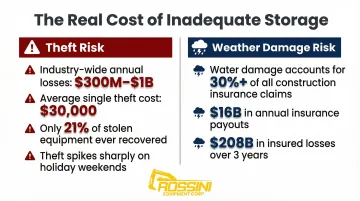
A $50/month savings disappears fast against a $30,000 theft or a $10,000 repair bill. Verify fencing, lighting, camera coverage, and on-site staffing before signing any storage agreement.
Conclusion
Heavy equipment storage rates vary widely based on machine size, storage format, contract length, and facility location. Knowing which factors drive costs helps you budget accurately and avoid overpaying. Outdoor storage offers the most affordable option for rugged machines and short-term needs, while covered and enclosed formats provide critical protection for sensitive equipment or extended storage periods.
Contractors and property owners in Sullivan County and the Hudson Valley should look for a storage provider with real equipment expertise, secure infrastructure, and flexible contract terms. Rossini Equipment Corp, based in Monticello, NY, offers exactly that — with over 25 years of experience handling heavy construction equipment.
Their yard provides secure short- and long-term parking for commercial vehicles and heavy equipment, with the practical knowledge to accommodate machines of varying size, weight, and access requirements.
For a customized storage quote or to discuss your equipment needs, contact Rossini Equipment Corp at (845) 794-1066 or office@rossiniequipmentcorp.com.
Frequently Asked Questions
How much does it cost to store heavy equipment per month?
Monthly rates range from $70–$150 for compact equipment, $150–$400 for mid-size machines, and $300–$800+ for large equipment in outdoor storage. Storage type (outdoor, covered, or enclosed) and location drive most of the variation, with rural facilities typically cheaper than urban markets.
What factors most affect heavy equipment storage rates?
The top variables are equipment size and footprint, storage format (outdoor, covered, or enclosed), contract length (month-to-month vs. long-term agreements), and facility location. Security features like fencing, surveillance, and gated access also justify higher rates.
Is outdoor storage okay for heavy equipment, or does it need to be covered?
Most heavy equipment handles outdoor storage well short-term, but extended exposure is a different story. Equipment with sensitive electronics, hydraulics, or painted finishes should be in covered or enclosed storage to prevent weather damage and corrosion.
How much does it cost to store an excavator?
A mid-size excavator (20,000–30,000 lbs) typically costs $150–$300 per month for outdoor fenced yard storage, $200–$400 for covered storage, and $300–$500 for fully enclosed storage. Rates vary based on machine size, storage duration, and facility location.
What should a heavy equipment storage agreement include?
A complete agreement should cover access terms, security provisions (fencing, surveillance, lighting), liability and insurance responsibilities for theft or damage, required notice period for vacating, and any restrictions on equipment type or size.
Can I store heavy equipment at a rental yard between jobs?
Yes, many equipment dealers and rental yards offer short- and long-term storage. It's a practical option — the facility's team already knows your equipment, and you may get access to on-site servicing or condition checks while it's parked.