

This scenario plays out constantly across the Hudson Valley. Contractors, builders, and property owners budget for the visible work — gravel, fill, basic grading — and leave out the site-specific preparation costs that only become clear once boots are on the ground. The result? Projects that blow past budgets, timelines that stretch, and unexpected invoices that strain relationships and cash flow.
This guide breaks down every cost category that commonly gets overlooked when planning access road projects in the Hudson Valley, so you can walk into your next project with a realistic number — and avoid the mid-project surprises that turn straightforward builds into budget battles.
TLDR:
- Surveying, drainage, and permits add 30-50% to base material costs
- Hudson Valley's glacial soils and freeze-thaw cycles require deeper bases than flat, sandy sites
- Land clearing in wooded areas costs $4,500-$10,000+ per acre, not the $1,500 often assumed
- Proper compaction and drainage prevent costly washouts and frost heave repairs
- Working with experienced regional contractors helps identify hidden site conditions early
Why Access Road Costs Are Easy to Underestimate
Most initial quotes only cover visible, above-ground work: gravel, fill material, and basic grading. They leave out site-specific preparation costs that only surface after the contractor walks the site, reviews soil maps, and assesses drainage patterns.
The problem? Property owners and even experienced builders often commit to budgets before these assessments happen, assuming that "a road is a road" and that rough cost-per-foot estimates will hold.
Access roads vary dramatically in scope. A 300-foot gravel farm road built on flat, sandy loam looks nothing like a 300-foot commercial site access road crossing a steep wooded hillside with clay subsoil and a seasonal stream. Yet both are often budgeted with the same rough mental estimate — "$50 per foot, so $15,000 total" — leading to surprises when the commercial road ends up costing $35,000 once clearing, drainage, and subgrade correction are factored in.
Key variables that affect cost:
- Terrain slope and elevation changes
- Soil type and bearing capacity
- Road length, width, and intended load (light vehicles vs. heavy trucks)
- Vegetation density and clearing requirements
- Proximity to wetlands, streams, or protected areas
- Seasonal access and weather-related construction windows
Most of these variables only become clear during a proper site assessment — which is exactly why skipping that step early tends to cost more later. Common mid-project surprises include:
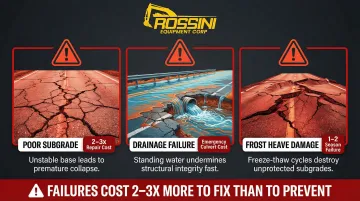
- Poor subgrade conditions discovered mid-build, requiring excavation and material replacement
- Drainage failures after the first heavy rain, triggering emergency culvert installation
- Frost heave damage within one winter, requiring costly surface repairs
These failures typically cost 2–3 times more to fix than they would have cost to prevent during initial construction.
The Hidden Costs Most Access Road Budgets Miss
Surveying and Land Assessment
Before any equipment breaks ground, a topographic survey is needed to understand elevation changes, drainage patterns, property boundaries, and soil bearing capacity. This cost is routinely left out of early estimates, yet it's the foundation for accurate design and permitting.
Survey cost ranges:
- Drone photogrammetry: $1,500-$3,000 for sites 5-50+ acres (open terrain)
- Drone LiDAR: $3,000-$6,000+ for wooded sites requiring ground surface measurement through canopy
- Traditional ground survey: $2,000-$10,000 for small lots under 5 acres needing legal boundary verification
Drone surveys cost 50-75% less than traditional methods for larger sites, but heavily wooded Hudson Valley parcels often require LiDAR to penetrate the tree canopy, which adds 50-100% over open-terrain pricing.
When to add geotechnical testing:
A geotechnical assessment (soil borings, bearing capacity tests, moisture content analysis) is warranted when:
- Soil maps indicate clay-heavy soils, shallow rock, or fragipan layers
- The site has visible drainage issues or standing water
- The road will carry heavy truck traffic or equipment loads
- Previous construction in the area encountered subgrade failures
Geotechnical testing costs $1,500-$5,000+ depending on the number of borings and lab tests required, but it prevents costly mid-project subgrade failures that can add $10,000-$20,000 in emergency repairs.
Land Clearing and Right-of-Way Preparation
Clearing involves removing trees, stumps, brush, rocks, and debris along the road corridor. The cost scales significantly with vegetation density and lot conditions. Right-of-way clearing on wooded rural land — common in Sullivan County — can be one of the biggest line items in an access road budget.
Land clearing costs in New York:
- Brush and scrub: $1,200-$2,500 per acre (vegetation under 4" diameter)
- Light timber: $2,500-$4,500 per acre (mixed softwoods, 4-12" diameter)
- Heavy timber: $4,500-$8,000 per acre (mature hardwoods 12"+, dense canopy)
- Overgrown/mixed: $3,500-$10,000+ per acre (abandoned parcels with structures, stone walls, debris)
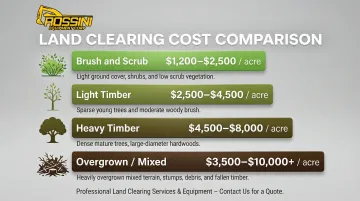
A flat lot with scrub brush might cost $1,500 per acre, while a hillside with mature hardwoods and stone walls can push past $10,000 per acre before grading even begins.
Stump removal and rock excavation premiums:
Full grubbing (removing stumps and root balls) adds $2,000-$5,000 per acre. In rocky soils — common across the Catskills and Hudson Valley — grubbing costs escalate to $3,500-$7,000 per acre because roots wrap around limestone and glacial rock formations, requiring hydraulic breakers and additional machine hours to extract.
Drainage System Installation
Proper drainage — including culverts, ditches, and swales — must be designed and installed to prevent washout, flooding, and subgrade failure. Skip it, and you're not saving money — you're deferring a much larger repair bill, especially in areas with heavy seasonal rainfall or snowmelt.
Why drainage fails in the Northeast:
Highway agencies spend more than 25% of their road maintenance budgets on drainage-related repairs. In the Northeast, inadequate drainage triggers what engineers call the "bathtub effect": during spring thaw, the roadbed thaws from the top down while frozen shoulders trap meltwater in the base and subgrade.
That trapped water saturates the material, dramatically reducing its load-bearing strength. The result is premature failure — ruts, potholes, and in severe cases, complete subgrade collapse.
Minimum culvert standards:
- No culvert should be less than 18 inches in diameter for road drainage
- Driveway culverts should be minimum 12 inches
- Undersized culverts clog with debris and cause washouts during heavy rain
Drainage installation costs:
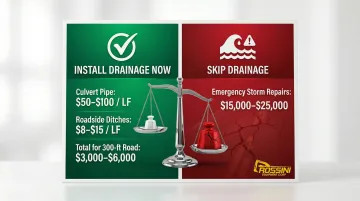
- 18-24" culvert pipe: $50-$100 per linear foot installed (including excavation and backfill)
- Roadside ditches: $8-$15 per linear foot for excavation and shaping
- Swales and grading for surface drainage: $5-$10 per linear foot
For a 300-foot access road, drainage infrastructure alone can add $3,000-$6,000 to the project cost — but skipping it can result in $15,000-$25,000 in emergency repairs after the first major storm.
Grading and Compacting
Forming a stable road surface requires multiple passes of excavation, rough grading, subbase placement, and compaction. Each step requires specific equipment: motor graders, vibratory rollers, and compactors. This phase often takes longer and uses more machine hours than owners anticipate.
Equipment requirements:
- Motor grader (125-205 HP): $860-$1,255 per day rental
- Vibratory roller (80-89" drum): $885 per day rental
- Rammer compactor: $112 per day rental
These rates exclude mobilization, fuel, and operator costs, which can add 20-30% to equipment expenses.
Compaction standards:
Achieving proper subgrade density is critical for long-term road performance. Engineers typically specify 95-100% of Standard Proctor (AASHTO T-99) maximum density for roads carrying structural loads. This requires 4-5 passes with vibratory roller compaction equipment to attain maximum practical density.
What happens when compaction is rushed:
Roads built on insufficiently compacted subgrade fail within 1-2 seasons. The base settles unevenly, creating ruts and low spots that collect water, and frost heave accelerates surface damage through winter freeze-thaw cycles.
Getting compaction right the first time requires the correct equipment and experienced operators. Redoing the work doesn't just cost more — it typically doubles both time and total expense.
Permits, Easements, and Regulatory Compliance
Building an access road — even on private property — often requires permits from local municipalities, NYS DEC wetlands permits if the road is near water or wetlands, and potentially highway work permits if the road connects to a public road. Permit fees and the time to obtain approvals can add both direct costs and project delays.
Key New York State permit requirements:
NYSDEC Freshwater Wetlands (Article 24):
- Wetlands 12.4 acres or larger (dropping to 7.4 acres in 2028) are regulated
- A 100-foot adjacent area buffer is also regulated
- Road construction is considered a major project requiring a permit
SPDES Construction General Permit:
- Required for soil disturbances of 1+ acres statewide
- Requires erosion control plans and stormwater management
- Permit processing time: 4-8 weeks
NYSDOT Highway Work Permit:
- Required for any driveway or access road connecting to a state highway
- Commercial access requires PERM 33-COM application
- Review and approval time: 6-12 weeks
These regulatory requirements carry real costs — both in fees and in timeline.
Permit cost estimates:
- Wetlands permit application and engineering: $2,500-$8,000
- SPDES permit and erosion control plan: $1,500-$4,000
- Highway work permit and design review: $1,000-$3,000
Beyond direct costs, permit delays can push projects into unfavorable weather windows, adding mobilization costs and extending timelines by 2-3 months.
Ongoing Maintenance
Access roads — particularly unpaved gravel roads — require regular maintenance: regrading after winter, adding fresh gravel, clearing drainage channels, and repairing frost heave damage. Most initial build budgets never account for this recurring cost, but it belongs in any honest total cost of ownership calculation.
Annual maintenance tasks:
- Regrading and crown restoration: $500-$1,500 per year (300-foot road)
- Fresh gravel topdressing: $800-$2,000 per year (2-3" depth)
- Drainage channel clearing: $200-$500 per year
- Pothole and washout repairs: $300-$1,000 per year (variable)
Over a 10-year period, maintenance costs for a 300-foot gravel access road can total $15,000-$40,000 — often exceeding the initial construction cost. Planning for maintenance from the start isn't pessimism — it's how you avoid a $40,000 surprise ten years down the road.
How Site Conditions in the Hudson Valley Drive Costs Higher
Sullivan County and the broader Hudson Valley region present specific challenges that contractors working in other parts of New York don't always encounter. These regional factors push access road costs 20-40% higher than projects on flat, sandy sites.
Rocky Subsurface and Glacial Deposits
The Hudson Valley's geology is dominated by glacial till (a mix of clay, silt, sand, gravel, and boulders deposited by retreating ice sheets). Sullivan County soils like the Lackawanna channery loam and Wurtsboro extremely stony series feature shallow fragipans at 17-36 inches depth.
These fragipans are compacted hardpan layers that resist standard excavation. Surface areas can also contain up to 9% cobbles, stones, and boulders.
These conditions require:
- Hydraulic breakers to fracture rock and hardpan layers
- Additional excavation to remove unsuitable material
- Deeper aggregate bases to compensate for poor subgrade bearing capacity
Clay-Heavy Soils and Low Bearing Capacity
Clay soils retain moisture and become unstable when saturated. The Hudson Valley's clay-heavy loams have low bearing capacity and are highly frost-susceptible, meaning they expand and contract significantly during freeze-thaw cycles.
Roads built on clay subgrade without proper undercut and base depth fail fast: rutting, cracking, and frost heaves within one or two winters.
Frost Depth and Freeze-Thaw Cycles
Frost depths in this region reach 36-48 inches, causing heave in roads built on insufficient base depth. New York State pavement guidelines for frost-susceptible soils set minimum thicknesses as follows:
- Standard frost-susceptible soils: at least 15 inches total pavement section
- Highly frost-susceptible soils: up to 36 inches total pavement section
- Minimum granular base below the wearing course: 12 inches of clean, non-frost-susceptible material
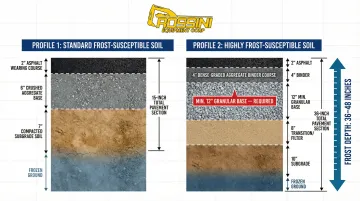
Cutting corners on base thickness to save $3,000-$5,000 upfront leads to cracked, rutted roads that require $15,000-$25,000 in reconstruction within two seasons.
Wetland and Waterway Proximity
Wetlands and waterways are common throughout the Hudson Valley. Building near or across them introduces environmental protection costs:
- Erosion control measures (silt fences, sediment barriers)
- Engineered crossing solutions (bridges, oversized culverts)
- Regulatory compliance and permit review
These measures add $5,000-$15,000 to projects that would otherwise be straightforward.
Remote and Sloped Parcels
Remote or sloped parcels, common in Sullivan County's rural areas, add mobilization costs. Equipment must be transported to the site, and on steep grades, additional work is required to establish safe working conditions before road formation begins.
Mobilization cost factors:
- Equipment transportation: 10% of project subtotal (typical estimate)
- Demobilization: 5% of project subtotal
- Steep grade preparation: $2,000-$5,000 for temporary access and safety measures
These costs are rarely included in initial per-foot estimates but can add $3,000-$8,000 to a mid-sized access road project.
What Does Building an Access Road Actually Cost?
Cost-per-linear-foot estimates vary widely based on road width, terrain, base depth, and surface type. Here's what realistic 2025 pricing looks like for the Hudson Valley market.
Basic Unpaved Gravel Access Road
Cost range: $25-$45 per linear foot for a 12-14 foot wide single-lane gravel road with 6-8 inch crushed stone base and 2 inch gravel wearing course.
What's included:
- Subgrade preparation and compaction
- 6-8" crushed stone base (non-frost-susceptible material)
- 2" gravel wearing course
- Basic crown grading for surface drainage
What's NOT included:
- Land clearing (add $1,200-$10,000 per acre)
- Drainage infrastructure (add $3,000-$6,000 for culverts and ditches)
- Surveying and permits (add $2,000-$8,000)
- Mobilization and demobilization (add 15% of subtotal)
What moves the number up or down:
- Road width: 16-foot two-lane roads cost 30-40% more than 12-foot single-lane
- Terrain: Steep slopes add 20-30% for additional grading and safety measures
- Base depth: Frost-susceptible soils requiring 12-18" base add $8-$15 per linear foot
Asphalt-Paved Access Road
Cost range: $65-$95 per linear foot for a 14-16 foot wide paved road with 8-10 inch crushed stone base and 2-3 inch asphalt surface.
What's included:
- Subgrade preparation and compaction
- 8-10" crushed stone base
- 2-3" asphalt surface (base and finish courses)
- Basic crown grading and edging
Long-term trade-offs:
Asphalt runs 2-3 times more upfront, but the maintenance gap narrows over time:
- Asphalt: seal coat every 3-5 years ($3-$5/sq ft) plus occasional crack repair
- Gravel: annual regrading and topdressing every year
- 15-year total cost of ownership: comparable between both options
- Asphalt advantages: lower dust, better aesthetics, easier snow removal
Real-World Project Example
Scenario: 300-foot private access road on a moderately sloped wooded lot in Sullivan County, 14 feet wide, unpaved gravel surface.
| Line Item | Cost |
|---|---|
| Land clearing (0.5 acre, heavy timber) | $3,500 |
| Surveying (drone photogrammetry) | $2,000 |
| Subgrade prep and compaction (300 LF × 14' wide) | $2,100 |
| Crushed stone base (8" depth, 35 tons) | $1,500 |
| Gravel wearing course (2" depth, 9 tons) | $400 |
| Drainage (one 18" culvert, 40 LF ditch) | $2,800 |
| Grading and shaping (motor grader, 3 days) | $2,600 |
| Compaction (vibratory roller, 2 days) | $1,800 |
| Mobilization/demobilization (15%) | $2,500 |
| Permits (local highway work permit) | $1,200 |
| TOTAL | $20,400 |
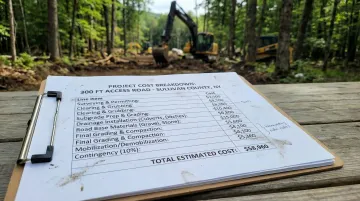
Cost per linear foot: $68 — well above than the $25-$45 base range because of clearing, drainage, and site-specific conditions.
Load Requirements and Road Width
A single-lane gravel road for light vehicle access (pickup trucks, SUVs) costs far less than a two-lane road engineered for heavy truck or equipment traffic.
Load class drives both width and base depth requirements:
- Light vehicle access (cars, pickups): 12' width, 6" base = baseline cost
- Heavy equipment access (dump trucks, excavators): 14-16' width, 10-12" base = 40-60% cost increase
- Year-round commercial traffic: 16-18' width, 12-18" base, asphalt surface = 150-200% cost increase
Nail down load requirements before finalizing any budget. A road built for light vehicles that later carries loaded dump trucks will fail rapidly — and reconstruction costs more than building it right the first time.
How to Plan Your Access Road Budget and Avoid Surprises
Start with a proper site walk and soil assessment before requesting any quotes. Bids based on road length alone are almost always incomplete. Accurate bids require on-site evaluation of terrain, drainage needs, existing vegetation, and soil conditions.
Site assessment checklist:
- Walk the proposed road corridor from end to end
- Identify trees, stumps, and vegetation density
- Note elevation changes, slopes, and drainage patterns
- Check soil maps for clay content, rock, and fragipan layers
- Identify wetlands, streams, or water features within 100 feet
- Confirm property boundaries and easement requirements
- Photograph site conditions for contractor reference
Build a contingency buffer into the budget — typically 10-20% of the estimated project cost — specifically to account for subgrade failures, permitting delays, or drainage complications discovered mid-project. Site construction projects routinely encounter unforeseen conditions: buried boulders, higher-than-expected water tables, or clay layers deeper than soil maps indicated. Without that buffer, these discoveries can stall work until additional funds are secured.
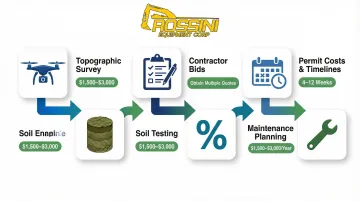
Budget planning steps:
- Get a topographic survey ($1,500-$3,000 for drone survey)
- Request soil testing if maps indicate poor conditions ($1,500-$3,000)
- Obtain multiple contractor bids based on site walk and survey data
- Add 10-20% for mobilization and contingency
- Factor in permit costs and timelines (4-12 weeks for approvals)
- Plan for ongoing maintenance ($1,500-$3,000 per year for gravel roads)
Regional experience matters here. Equipment providers and contractors who know your local soil types, drainage patterns, and terrain can flag problems before they show up on an invoice.
Rossini Equipment Corp. has operated out of Monticello, NY since 1998, with family roots in New York construction going back to 1963. That history means their team has encountered the clay layers, rock outcroppings, and water table surprises common to Sullivan County and the Hudson Valley — and they know which equipment handles those conditions without rework. If your site prep plan needs a second set of experienced eyes, that kind of local knowledge is worth a phone call before breaking ground.
Frequently Asked Questions
How much does 100 feet of road cost?
A basic 12-foot wide unpaved gravel road runs approximately $25-$45 per linear foot — or $2,500-$4,500 for 100 feet — covering subgrade prep, crushed stone base, and gravel wearing course. Terrain, drainage requirements, and frost-susceptible soils routinely push that to $60-$80 per linear foot once clearing and culverts are factored in.
How much does a 200 ft asphalt driveway cost?
A 200-foot asphalt driveway (14-16 feet wide) costs approximately $13,000-$19,000, including subgrade prep, 8-10 inch crushed stone base, and 2-3 inch asphalt surface. Site conditions, driveway width, and required base depth — especially in freeze-thaw climates like New York where 12-18 inch bases are often necessary — are the main variables that affect final cost.
Do I need a permit to build an access road on my property in New York?
It depends on scope, but several conditions commonly trigger permitting in New York: connections to public roads, wetland proximity (within 100 feet of regulated wetlands), and soil disturbances over 1 acre. NYSDOT requires highway work permits for state road connections; NYSDEC requires wetlands permits for work in or near regulated freshwater wetlands.
What soil conditions make access road construction more expensive?
Clay-heavy soils, high water tables, organic subgrade, and rocky glacial deposits all require undercutting, engineered fill, and deeper aggregate bases — driving costs up sharply. These conditions are common in Sullivan County (particularly the Lackawanna and Wurtsboro soil series), where frost heave and subgrade failure are real risks without proper base preparation.
What is the difference between a temporary and permanent access road?
Temporary roads use surface mats or minimal gravel for short-term use — logging, construction staging — with limited subgrade work and no engineered drainage. Permanent roads require 12-18 inches of non-frost-susceptible base, minimum 18-inch culverts, and surface materials built for long-term load-bearing and freeze-thaw cycles. That level of construction typically costs 3-5 times more than a temporary solution.