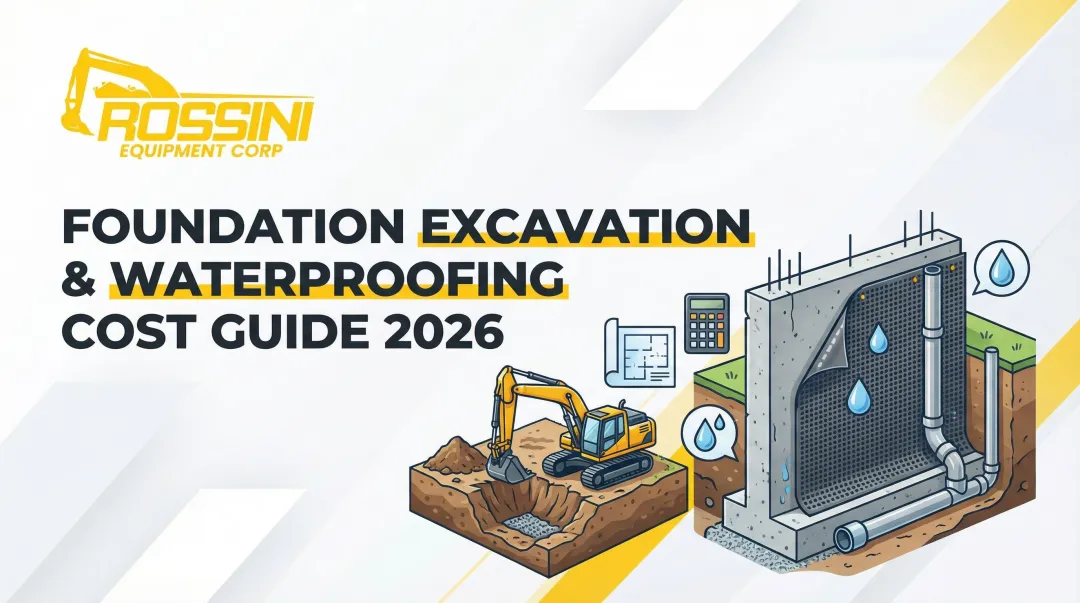
This guide covers foundation-specific pricing ranges, the factors that move costs up or down, what's often left out of quotes, and how to budget and save smartly before breaking ground.
TL;DR
- Foundation excavation costs range from $1,500 for a simple slab to $15,000+ for a full basement — hillside or rocky sites can exceed $20,000.
- Soil type, excavation depth, site accessibility, and underground obstacles are the biggest cost drivers.
- Slab foundations cost the least; full basements cost the most; crawl spaces fall in the middle.
- Planning ahead, bundling site work, and reusing excavated soil on-site can cut costs significantly.
How Much Does Foundation Excavation Cost?
Foundation excavation does not have a fixed price. Costs depend on foundation type, project scale, soil conditions, and site specifics, with most residential work ranging from $1,500 to $15,000+.
What commonly goes wrong when budgeting? Underestimating soil disposal costs, choosing a foundation type without understanding its excavation depth, or being blindsided by rocky terrain or underground obstructions. These oversights can add thousands to the final bill.
Foundation Type and Typical Cost Ranges
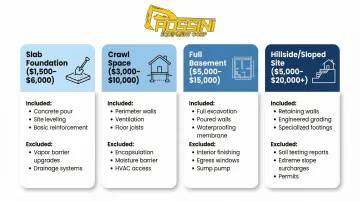
| Foundation Type | Typical Cost Range | What's Included | What's Usually Excluded |
|---|---|---|---|
| Slab Foundation | $1,500–$6,000 | Labor, equipment, basic soil haul-off for minimal excavation and site leveling | Permits, soil testing, post-dig grading |
| Crawl Space | $3,000–$10,000 | Labor, equipment, moderate-depth digging, soil removal | Permits, soil testing, drainage work |
| Full Basement | $5,000–$15,000 | Labor, equipment, deep excavation, large-volume soil removal, often shoring for safety | Permits, soil testing, waterproofing, post-dig grading |
| Hillside/Sloped Site | $5,000–$20,000+ | Labor, equipment, slope stabilization, erosion control measures | Retaining walls, specialized drainage, permits |
How Contractors Price Foundation Excavation
Contractors use three common pricing models:
- Per cubic yard ($50–$200) — the most transparent method; scales directly with soil volume removed. Sandy or loamy soil sits at the low end; rocky terrain or clay pushes toward the high end.
- Hourly rate ($100–$300) — used when site conditions are unpredictable. Smaller machines cost less per hour but take longer; larger excavators cost more but finish faster.
- Flat project fee — common for well-defined residential jobs. Provides budget certainty but requires clear scope definition upfront.
Calculating Cubic Yard Cost:
Use this formula to estimate excavation volume:
Length × Width × Depth (in feet) ÷ 27 = Cubic Yards
Example — a typical residential basement at 24' × 30', dug 8 feet deep:
- 24 × 30 × 8 = 5,760 cubic feet
- 5,760 ÷ 27 = 213 cubic yards
- At $50–$200 per cubic yard: $10,650–$42,600
Real-world residential jobs typically land between $5,000–$15,000 because soil conditions are standard and dimensions are smaller than worst-case estimates. For reference, excavating 200 cubic yards at the same rate range runs $10,000–$40,000 — soil type and site access are the biggest cost variables at that volume.
Key Factors That Drive Foundation Excavation Costs
Several technical and site-specific variables determine whether a foundation excavation comes in at the low end or blows the budget. Knowing what drives costs before getting quotes puts you in a stronger negotiating position.
Soil Type and Ground Conditions
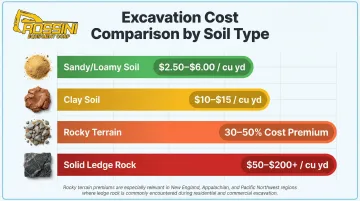
Soil type is often the single biggest swing factor in excavation pricing. Cost ranges by material:
- Sandy or loamy soil — easiest to excavate; typically $2.50–$6.00 per cubic yard
- Clay soil — requires more machine power and time; $10–$15 per cubic yard, adding $200–$1,200 to total cost
- Rocky terrain — 30–50% more expensive than standard soil
- Solid ledge rock — $50–$200+ per cubic yard to remove; some projects add $1,000–$20,000+ in rock removal fees alone
In Sullivan County and the Hudson Valley, rocky subsurface conditions are particularly common. USDA soil data reveals the region is dominated by stony loamy till and shallow fragipan, often encountered at depths of 12–36 inches. You can start a dig on workable topsoil and hit solid bedrock before lunch — making hydraulic breaker attachments essential equipment for most foundation work in this area.
Two additional conditions to factor in early:
- High water table — dewatering equipment adds $3,000–$10,000 to project cost
- Soil testing ($150–$400) — a straightforward investment that prevents costly surprises mid-dig
Excavation Depth
Deeper digs require more equipment hours, more soil removal and disposal, and additional safety measures such as shoring or sloping to prevent collapse. Moving from a shallow slab excavation to a full basement can double or triple total cost.
One rule to know: OSHA requires protective systems — sloping, shoring, or trench boxes — for excavations deeper than 5 feet. Most experienced contractors start planning for slope stability at 4 feet. That extra planning adds time and cost, particularly for full basements where excavation routinely reaches 8 feet or more.
Site Accessibility and Terrain
Limited access forces contractors to use smaller or specialized equipment that takes longer to complete the same volume of work. Constrained sites — tight urban lots, steep slopes, fenced properties, or proximity to existing structures — can add 15–25% to base excavation costs.
**Excavating around an existing foundation** (for waterproofing, drainage repair, or an addition) is more expensive than open-site new construction because of the precision required and risk of disturbing the existing structure. Expect $5,000–$15,000 for most residential jobs, or $100–$250 per linear foot.
Full Cost Breakdown: Where Your Money Goes
The quoted excavation price rarely covers everything. Here's what goes beyond the base dig cost:
| Line Item | Typical Cost | Notes |
|---|---|---|
| Permit Fees | $50–$400 | Required before excavation; complex sites may cost more |
| Land Survey | $400–$550 | Confirms property lines; ALTA surveys run $2,500–$10,000 |
| Soil Testing | $150–$400 | Basic tests; full geotechnical reports cost $1,000–$5,000 |
| Soil Disposal/Hauling | $8–$25 per cubic yard | Varies by distance and material type |
| Post-Dig Grading | $400–$6,500 | Removes excess dirt, creates proper drainage slope |
These line items add up fast, and labor is often where the total climbs most. Operators who own their machines can quote lower rates than contractors renting equipment and billing that cost back to you. Equipment rental alone runs $100–$250 per hour, which is why owner-operated setups tend to keep total project costs lower.
Contractors typically bill grading and site cleanup after the dig as separate line items. If the same crew is handling drainage or backfill, ask for an itemized quote upfront — that way you know exactly what's included and what triggers an add-on charge.
How to Save Money on Foundation Excavation
Smart timing and project bundling are two of the most effective ways to reduce cost:
Schedule during slower contractor months: Late fall or early winter in mild climates can improve pricing as contractors seek to maintain cash flow. However, in regions with frozen ground, savings may be negated by slower machine productivity.
Bundle site work: Combining foundation excavation with grading, drainage trenching, or utility trenching in a single mobilization reduces equipment transport costs and often unlocks volume pricing.
Reuse excavated soil on-site: Using excavated material for backfill, grading, or berms instead of paying to haul it all away is a direct cost reduction.
Get at least three itemized quotes: Request detailed breakdowns, not just totals. This reveals where estimates differ and what's being excluded.
In Sullivan County and the Hudson Valley, variable soil and rocky ground can turn a straightforward dig into a far more complex job — and that's where local knowledge matters. Rossini Equipment Corp., backed by a family construction legacy going back to 1963, brings over 60 years of combined industry experience to the region's toughest terrain.
Operating out of Monticello, the company offers flexible equipment rentals with or without an operator, so contractors and property owners can right-size their approach and avoid budget surprises when ledge rock is a real possibility.
When DIY Makes Sense (and When It Doesn't):
DIY is realistic for small landscape trenches and minor grading with a rented mini-excavator. It is not advisable for anything deeper than a few feet, digs near existing structures, or rocky or unstable ground. Mistakes in foundation excavation create structural and safety hazards that cost far more to correct than hiring a professional from the start.
What Most People Get Wrong About Excavation Costs
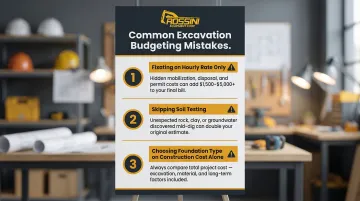
Three pricing mistakes consistently inflate excavation budgets — and all three are avoidable.
Fixating on the hourly or cubic-yard rate: Permits, soil testing, hauling, and post-dig grading can add $1,500–$5,000 or more on top. Always request a scope-of-work document, not just a number.
Skipping soil testing to save upfront: Rocky ledge, high groundwater, or contaminated fill discovered mid-dig requires specialized equipment or regulatory handling. These surprises can double the original estimate.
Choosing a foundation type based on construction cost alone: A full basement costs more to excavate than a slab or crawl space, but may be more cost-effective long-term. Making the right call means comparing total project cost, not just above-ground construction.
Frequently Asked Questions
How much does it cost to excavate a foundation?
Costs vary by foundation type: slab foundations run $1,500–$6,000, crawl spaces cost $3,000–$10,000, and full basements range from $5,000–$15,000. Soil conditions and site access significantly affect the final number.
How do you calculate the cost of excavation for a foundation?
Calculate volume using Length × Width × Depth (in feet), then divide by 27 to convert to cubic yards. Multiply by the contractor's per-cubic-yard rate ($50–$200 depending on soil and region). Add additional costs like permits, soil testing, and hauling to the base volume calculation.
How much does it cost to dig around a foundation?
Excavating around an existing foundation for waterproofing, drainage, or an addition typically costs $5,000–$15,000 for residential work. Costs rise when precision is required to avoid disturbing the existing structure.
How much does it cost to excavate 200 cubic yards?
At $50–$200 per cubic yard, 200 cubic yards would cost roughly $10,000–$40,000 depending on soil type, site conditions, and regional labor rates. This is a useful benchmark for estimating basement-scale foundation digs.
Is it cheaper to dig down or build up?
Building up (adding a floor above grade) is generally less expensive than digging down for a basement. Excavating a new basement costs $30–$75 per square foot just for the dig, while adding a second story costs $100–$300 per square foot for the complete build. The best answer depends on site conditions, local costs, and long-term use plans.
What is the 4 foot rule for excavation?
The "4-foot rule" is a common jobsite practice where contractors begin planning for slope and wall stability at 4 feet of depth. OSHA mandates protective systems and safe egress for excavations at or beyond this threshold, making it a critical planning benchmark for basement and deep crawl space work.