Introduction
According to the National Association of Home Builders, excavation, foundation, concrete, retaining walls, and backfill now account for 10.0% of total construction costs — a figure that has climbed sharply as construction costs rose 4.2% in 2025 alone. For any new build or basement repair project, these line items carry serious weight.
For homeowners and contractors planning projects in the Northeast and Hudson Valley market, understanding these costs is critical. Combined excavation and waterproofing projects typically range from $15,000 to $35,000+ for exterior systems, with interior-only solutions running $4,000 to $8,000. The final number depends on several site-specific factors:
- Soil type and rock content
- Excavation depth and volume
- Site access and equipment constraints
- Foundation size and perimeter length
This guide gives contractors, builders, and property owners a practical cost breakdown — with regional pricing context for 2026 projects in New York and the Hudson Valley.
TL;DR
- Combined excavation and waterproofing costs range from $15,000 to $35,000+ for exterior systems; interior-only runs $4,000 to $8,000
- Soil type, excavation depth, site access, and foundation size are the biggest cost drivers
- Exterior waterproofing stops water at the source; interior systems manage it after it enters — at lower upfront cost
- Cutting corners on excavation or chasing the cheapest bid typically creates costlier repairs down the road
How Much Does Foundation Excavation and Waterproofing Cost?
There is no single fixed price for foundation excavation and waterproofing. Costs depend heavily on the method chosen, project scope, soil and site conditions, and local labor rates. The Northeast and New York market tends to run higher than national averages—construction laborers in the NY-Newark-Jersey City metro area earn $32.80 per hour, 38.4% higher than the $23.69 national average.
Two common budget mistakes plague these projects: underestimating excavation as a separate cost item, and treating waterproofing as optional rather than foundational. Both errors lead to scope creep and budget overruns.
Excavation Cost Ranges
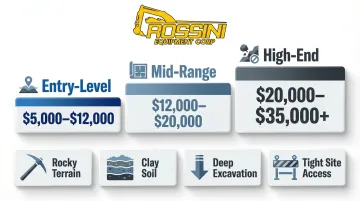
| Tier | Typical Range | Project Profile |
|---|---|---|
| Entry-Level | $5,000–$12,000 | Shallow depth (under 5 ft), small footprint, soft soil, easy access. Excludes waterproofing, backfill, and permits. |
| Mid-Range | $12,000–$20,000 | Standard basement (700–1,000 sq ft), full depth, debris hauling, site prep for waterproofing. Workable soil, reasonable access. |
| High-End | $20,000–$35,000+ | Large or deep foundations, restricted access, rocky or clay-heavy soil, combined excavation with exterior waterproofing systems. |
Most residential projects in the Hudson Valley and Sullivan County fall in the mid-range tier. The high-end tier kicks in when site conditions fight back. Key cost drivers:
- Excavation depths exceeding 8 feet (triggers OSHA protective system requirements)
- Rocky terrain requiring jackhammering or blasting ($50–$200+ per cubic yard vs. $2.50–$15 for standard soil)
- Clay-heavy soils that add 25–50% to base excavation costs
- Tight lots requiring smaller equipment or additional manual labor
Waterproofing Cost Ranges
Interior Waterproofing Only ($4,000–$8,000)
Interior systems include drainage channels, sump pump installation, and vapor barriers. This approach skips excavation entirely — faster to install and far less disruptive to the property. Installation typically takes 1–3 days, making it the practical choice for finished basements or properties with limited exterior access. The trade-off: it manages water after it enters rather than stopping it at the wall.
Exterior Waterproofing ($7,000–$15,000+)
This is the waterproofing component alone, separate from excavation costs. Exterior waterproofing requires full excavation, membrane application, drainage installation, and backfill. It's the more comprehensive and longer-lasting solution, typically lasting decades with minimal maintenance. Full-perimeter exterior waterproofing for an average home in the New York area runs $12,000 to $18,000.
When budgeting a complete exterior system, treat excavation and waterproofing as additive line items — the sections below break down what drives each cost higher or lower.
Key Factors That Affect the Cost of Foundation Excavation and Waterproofing
Pricing is shaped by a combination of site-specific, technical, and regional factors—no two projects are priced identically.
Soil Type and Ground Conditions
Clay-heavy soils, common in parts of the Hudson Valley and Sullivan County, require specialized heavy equipment, take longer to excavate, and can add 25–50% to base excavation costs compared to sandy or loamy soil. Clay becomes significantly heavier when wet, clings to bucket attachments, and slows excavation cycles considerably.
Rocky terrain is a separate cost category entirely. Hitting solid rock shifts excavation costs from $2.50–$15 per cubic yard to $50–$200+ per cubic yard for jackhammering or blasting. In the Catskills region, you might start a dig on workable topsoil and hit solid bedrock before lunch, which demands careful planning and the right equipment on standby.
Sullivan County is dominated by glacial till and bedrock outcrops, including loamy till derived from sandstone, siltstone, and shale. This mixed geology means contractors must prepare for variable conditions within a single excavation.
Excavation Depth and Foundation Size
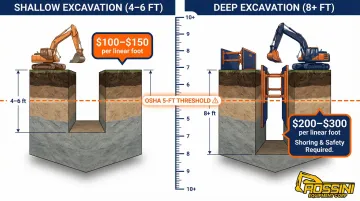
Deeper foundations (8+ feet) require more equipment time, larger machinery, increased safety measures, and more soil disposal. OSHA mandates protective systems (shoring, shielding, or benching) for excavations 5 feet or deeper, and safe egress is required at 4 feet. This shifts equipment needs from standard backhoes to heavy excavators and trench boxes, doubling per-linear-foot costs.
Cost scaling by depth:
- Shallow excavation (4–6 feet): $100–$150 per linear foot
- Deep excavation (8+ feet): $200–$300 per linear foot
Total square footage also scales material and labor costs for waterproofing. A 1,000 sq ft basement requires significantly more membrane material, drainage installation, and labor than a 400 sq ft foundation.
Site Access and Equipment Requirements
Tight lots, steep grades, or nearby structures prevent heavy machinery from maneuvering freely, requiring smaller equipment or additional manual labor, both of which increase cost and extend the timeline. This is especially relevant for older homes and infill lots common in small NY towns.
Working with an experienced excavation contractor prevents costly mobilization errors and delays. Rossini Equipment Corp's operators bring decades of regional field knowledge across Sullivan County and the Hudson Valley, selecting equipment suited to local terrain and constrained work environments.
Foundation Condition and Pre-Work Required
Foundations with existing cracks, structural movement, or inadequate drainage must often be repaired before waterproofing can be applied. These repairs can add $3,000–$15,000 depending on severity.
Excavation sometimes reveals hidden problems that weren't visible in the initial inspection:
- Deteriorated or crumbling foundation walls
- Undermined or exposed footings
- Unexpected utility lines running through the dig zone
- Inadequate or missing drainage around the existing foundation
Geographic Location and Permit Costs
Labor rates in the New York metro and Hudson Valley region run higher than rural Pennsylvania or Midwest markets. In the Kingston, NY metro area, construction laborers earn a mean hourly wage of $25.18, while the broader NY-Newark-Jersey City MSA averages $32.80—38.4% above the national mean.
Permit fees for excavation and structural work vary by municipality and typically range from $75–$500 or more depending on scope:
- Town of Sullivan, NY: $0.80 per sq. ft. for new single-family homes
- City of Kingston, NY: $100 minimum; $0.50 per sq. ft. for residential new buildings
- Town of Poughkeepsie, NY: $100 plus $0.20 per sq. ft. for new homes/additions
- Town of Liberty, NY: $35 minimum; $0.50 per sq. ft. for residential new construction
Permit processing alone can add 2–6 weeks to the overall timeline. Submit applications as soon as contractor bids are finalized to avoid scheduling gaps.
Cost Breakdown: What Goes Into the Final Number
The total project cost for foundation excavation and waterproofing is made up of several distinct line items. Understanding each one helps avoid sticker shock and allows for smarter budget planning.
Four cost categories make up most budgets:
- Excavation and soil removal
- Waterproofing materials and application
- Drainage system and sump pump installation
- Backfill, grading, and site restoration
Excavation and Soil Removal (One-Time)
Covers equipment time, operator labor, and hauling excavated material off-site. This is often priced per cubic yard ($50–$200) or per linear foot depending on the contractor. For a standard residential project, excavation and soil removal typically accounts for $5,000–$15,000 of the total budget.
Waterproofing Materials and Application (One-Time)
Includes the membrane, drainage board, sealants, and any crack repair compounds. Material grade directly affects longevity.
Per-square-foot waterproofing costs:
- Interior acrylic paint/sealant: $1–$8 per sq. ft.
- Interior silicate concrete sealer: $3–$9 per sq. ft.
- Exterior liquid membrane: $3–$6 per sq. ft.
- Exterior sheet membrane: $4–$7 per sq. ft.
Exterior membrane systems cost more per square foot than interior coatings, but they physically block water at the foundation wall rather than managing moisture after it enters — which is why they're preferred for new construction and full exterior excavations.
Drainage System and Sump Pump Installation (One-Time/Recurring)
Installation costs and ongoing maintenance requirements differ significantly here:
- Exterior French drain or weeping tile: $100–$300 per linear foot
- Sump pump installation: $1,200–$2,500 (one-time)
- Annual sump pump testing and servicing: $200–$400
- Full system cleaning: every 3–5 years
Backfill, Grading, and Site Restoration (One-Time)
Often overlooked in initial quotes, this includes returning excavated soil, compacting, regrading for proper drainage slope, and restoring any landscaping, patios, or hardscape disturbed during excavation. Yard grading and leveling typically costs $400–$6,500, depending on the extent of restoration required. Many contractors exclude site restoration from their base quotes — always request an itemized breakdown that lists this work separately before signing any contract.
Interior vs. Exterior Waterproofing — What's the Price Difference?
The core distinction comes down to where each system intervenes. Interior systems — drainage channels, sump pumps, vapor barriers — manage water after it enters and cost less because no excavation is needed. Exterior systems intercept water before it reaches the foundation wall, which requires full-depth excavation but delivers more comprehensive long-term protection.
System Comparison
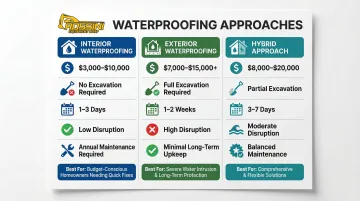
| Feature | Interior Waterproofing | Exterior Waterproofing | Hybrid Approach |
|---|---|---|---|
| Average Cost | $3,000–$10,000 | $7,000–$15,000+ | $8,000–$20,000 |
| Excavation Required | No | Yes | Partial (spot repairs) |
| Project Duration | 1–3 days | 1–2 weeks | 3–7 days |
| Disruption Level | Low | High | Moderate |
| Maintenance | Annual sump checks; $200–$400/year | Minimal long-term | Moderate |
| Best For | Budget constraints, minimal disruption | New construction, severe infiltration, long-term homeowners | High water table, phased budgets |
When Each Approach Makes Sense
- Interior waterproofing suits existing homes where budget or disruption is the primary concern. It manages water after entry — quick to install, but requires annual sump maintenance ($200–$400/year).
- Exterior waterproofing is the better long-term investment for new construction, severe infiltration, or high-water-table properties. It stops water at the source and lasts decades with minimal upkeep.
- Hybrid approaches pair spot exterior repairs with interior drainage — a practical middle ground for phased budgets or persistently wet sites.
What Most People Get Wrong When Budgeting for Foundation Work
Focusing Only on Waterproofing and Minimizing Excavation
Excavation done poorly or with inadequate equipment creates more expensive problems: foundation undermining, utility damage, and poor grading. The excavation phase sets up everything that comes after. Treating it as a line item to minimize is a costly mistake.
Ignoring Hidden and Post-Project Costs
Landscape restoration, permit fees, mold remediation (if water damage already exists), and debris disposal fees are frequently not included in initial contractor quotes. Budget an additional 10–20% contingency on top of the core project quote.
Interior systems also require ongoing maintenance costs (sump pump testing, occasional drain cleaning) that add up over time. Factor in $200–$400 annually for interior system upkeep.
Treating Excavation and Waterproofing as Separate Procurement Decisions
Coordinating both phases with contractors who understand the full scope reduces mobilization overlap, avoids scheduling gaps, and prevents costly restarts. In the Hudson Valley region, Rossini Equipment Corp brings that full-scope perspective — equipment selection, operator skill, and project sequencing aligned to local soil conditions and site constraints.
The Right Budget Accounts for Long-Term Protection Value
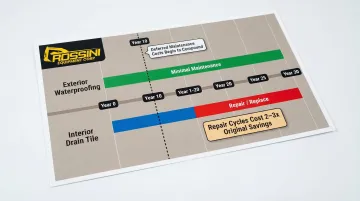
Exterior waterproofing systems, properly installed, carry a service life of 20–30 years. Interior drain tile systems average 15–25 years before requiring significant maintenance. Skipping or underinvesting in the excavation phase — the foundation for both — typically triggers repair cycles that cost two to three times the original savings within a decade.
Frequently Asked Questions
How much does it cost to excavate and waterproof a basement?
Interior-only waterproofing (no excavation needed) typically runs $4,000–$8,000, while a full exterior excavation and waterproofing project for a typical residential basement ranges from $15,000–$35,000 depending on size, soil conditions, depth, and location.
How much to waterproof a 1000 sq ft basement?
Waterproofing a 1,000 sq ft basement costs roughly $3,000–$10,000 depending on the method chosen. Interior sealants and drainage systems fall toward the lower end, while full exterior membrane systems with excavation push toward the higher end or beyond.
How much would a 20x20 foundation cost?
A 20x20 (400 sq ft) foundation excavation runs roughly $3,000–$7,000 for excavation alone. Add waterproofing, drainage, and site restoration on top of that—final cost depends on depth, soil type, and local labor rates.
Is interior or exterior waterproofing worth the extra cost?
Exterior waterproofing costs more upfront but stops water at the source and lasts decades with minimal maintenance. Interior systems are more affordable and less disruptive, but they manage symptoms rather than prevent entry. For long-term homeowners, exterior protection is the stronger investment.
How long does foundation excavation and waterproofing take?
Exterior excavation and waterproofing typically takes 1–2 weeks for a standard residential project once permits are in hand. Interior systems can be installed in 1–3 days. Permit processing alone can add 2–6 weeks, so factor that in before scheduling your contractor.
Can I waterproof my foundation without excavating?
Yes. Interior methods—drainage systems, sump pumps, crack injection, and vapor barriers—manage moisture without excavation and work well in most situations. That said, they don't stop water from pressing against the wall. For severe infiltration or long-term protection, exterior excavation and membrane application remains the preferred approach.