Introduction
You're standing in your driveway, looking at a crack that's widened from hairline to half an inch over the last two winters. Or it's the patio slab that's heaved and settled so badly it's become a trip hazard every time guests walk out the back door.
For property owners and contractors across Sullivan County and the Hudson Valley, concrete removal is often the first major site work decision of 2026 — and the one that catches most people off guard when the quotes arrive.
Concrete slab removal costs vary widely, from a few hundred dollars for a small, unreinforced pad to several thousand for a reinforced driveway or foundation. The difference usually comes down to factors most people don't think about until the quotes arrive: what's inside the concrete, how thick it is, and whether equipment can reach it without tearing up the yard.
This guide breaks down cost ranges by size and project type, the factors that push prices up or down, and what to watch for when budgeting a concrete removal job in 2026.
TL;DR
- Typical cost range: $2–$8/sq ft for standard concrete removal, including labor and disposal; total project costs run from $300 to $7,500+ depending on size and complexity
- What drives costs up: Rebar reinforcement, slab thickness over 6 inches, limited site access, and Northeast location pricing
- Who pays less: Property owners with small, unreinforced slabs in accessible areas who self-haul debris
- When spending more makes sense: Heavily reinforced slabs, confined spaces, or commercial-scale projects where experienced operators and proper equipment matter
How Much Does Concrete Slab Removal Cost in 2026?
Concrete removal costs vary more than most people expect. Two slabs that look identical on the surface can cost very different amounts to remove — based on what's inside them, how thick they are, and how equipment can access the site. Knowing the price drivers upfront helps you budget accurately and evaluate quotes with confidence.
Typical Cost Range by Slab Size
Contractors price concrete removal at $2–$8 per square foot, covering demolition labor and disposal fees. The low end applies to small, unreinforced, accessible slabs; the high end reflects reinforced concrete, thick pours, or tight site conditions.
| Slab Size (Sq. Ft.) | Cost Range |
|---|---|
| 100 | $200–$800 |
| 200 | $400–$1,600 |
| 400 | $800–$3,200 |
| 500 | $1,000–$4,000 |
| 1,000 | $2,000–$8,000 |
Note: Ranges apply to standard 3–6 inch thick slabs. For very large commercial slabs, contractors may shift to per-ton pricing instead.
What these ranges typically include:
- Demolition labor
- Equipment use (jackhammers, breakers, excavators)
- Hauling and transportation
- Dump fees and disposal
What they may exclude:
- Permits and inspection fees
- Concrete cutting as a separate line item
- Replacement materials or backfill
- Site restoration and landscaping
Price Range Breakdown
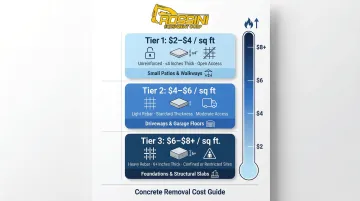
| Price Range | Typical Conditions | Common Projects |
|---|---|---|
| $2–$4/sq ft | Unreinforced, ≤4 inches thick, open access | Small patios, basic walkways, isolated sections |
| $4–$6/sq ft | Light rebar, standard thickness, moderate access | Driveways, patio removals, garage floors |
| $6–$8+/sq ft | Heavy rebar, 6+ inches thick, confined or urban sites | Commercial foundations, structural slabs, basement floors |
Key Factors That Affect Concrete Slab Removal Costs
Six variables drive most of the price variation in concrete slab removal. Knowing them before you request quotes helps you evaluate bids accurately and avoid surprises:
- Reinforcement type — rebar or wire mesh adds cutting and separate steel disposal
- Slab thickness — slabs over 6 inches require more saw cuts and hauling trips
- Site accessibility — limited access forces hand-breaking and manual carry-out
- Geographic location — labor rates and disposal fees vary sharply by region
- Permits and inspections — New York municipalities often require these for sidewalk and curb work
- Disposal method — dump fees vs. concrete recycling can swing costs significantly
Reinforcement Type
Unreinforced concrete breaks apart with standard hand tools and runs $2–$4 per square foot to remove. Reinforced slabs with rebar or wire mesh require cutting equipment to separate the steel, adding $1–$3 per square foot to the base rate. Removing reinforced concrete adds 50% to 100% more to the cost compared to non-reinforced slabs. The contractor must also dispose of the steel separately in many jurisdictions — some disposal sites charge an additional fee for mixed metal and concrete debris.
Slab Thickness
Standard pricing assumes 4–6 inches of thickness. Slabs over 6 inches often require cutting the concrete into smaller sections before removal, which adds significant labor time and can effectively double the cost per square foot. Going from 6 inches to 8 inches (just a 2-inch increase) triggers this jump because the slab becomes too heavy to lift in standard-sized pieces, requiring additional saw cuts and more hauling trips.
Site Accessibility
When equipment can roll directly to the slab, jobs move faster and cost less. Backyard slabs behind narrow gates, fenced areas, or elevated locations require hand-breaking and multiple carry-out trips, adding $1–$8 per square foot in labor.
Basement and indoor concrete removal falls into this same higher-cost category. Limited equipment access means crews must break the concrete into smaller pieces and haul debris through doorways and up stairs — a slow, labor-intensive process.
Geographic Location and Labor Rates
Concrete removal pricing varies significantly by region. The Northeast commands the highest concrete removal rates in the United States at $7–$14 per square foot, compared to Midwest and Southeast rates of $5–$10 per square foot. For property owners in Sullivan County, the Hudson Valley, and the broader New York area, this regional premium is driven by higher labor costs, stricter permitting requirements, and elevated disposal fees.
Permits and Inspections
Many municipalities in New York require permits for concrete removal, especially when the work affects public sidewalks, curb connections, or street access. Typical permit costs in New York State range from $50–$300+. For example, NYC DOT charges $70 for a sidewalk construction permit covering up to 300 linear feet, and some jurisdictions require a site inspection before the permit is issued, which adds to both cost and project timeline.
Disposal and Dump Fees
Disposal costs are often bundled into the per-square-foot rate, but not always. When itemized separately, dump fees typically run $50–$100 per ton nationally. Sullivan County's 2025 rate for construction and demolition debris is $130 per ton — one of the highest in the region.
Concrete recycling is worth considering as an alternative. Many recycling centers accept concrete debris at lower cost or free. Rockland Green's concrete crushing facility, for instance, accepts clean concrete for just $23 per ton, and crushed recycled concrete can sometimes be reused on-site as fill or base material.
Concrete Removal Cost by Project Type
Cost varies significantly based on what type of concrete structure is being removed. Size, structural role, and reinforcement requirements differ across project types, which is why a stair removal quote looks nothing like a driveway removal quote.
Here's a quick reference before diving into the details:
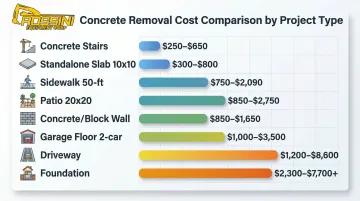
| Project Type | Typical Cost Range |
|---|---|
| Concrete driveway | $1,200–$8,600 |
| Garage floor (2-car) | $1,000–$3,500 |
| Patio (20x20) | $850–$2,750 |
| Standalone slab (10x10) | $300–$800 |
| Concrete stairs | $250–$650 |
| Sidewalk (50-foot run) | $750–$2,090 |
| Concrete/block wall | $850–$1,650 |
| Foundation | $2,300–$7,700+ |
Driveway and Garage Floor Removal
Concrete driveway removal typically costs $1,200–$8,600 depending on size and reinforcement. Driveways are usually reinforced and require excavator or bobcat access, pushing them into the mid-to-high cost range.
Garage floor removal runs $1,000–$3,500 for a 2-car garage and carries added complexity due to indoor constraints. Crews must break the slab into manageable sections and haul debris through the garage door opening, which slows the work down.
Patio and Slab Removal
Patio removal typically costs $850–$2,750 for a 20x20 patio. Patios are often unreinforced, which keeps costs toward the lower end unless they are unusually thick or attached to the home's foundation. A standalone 10x10 slab runs $300–$800, making it one of the most affordable concrete removal projects.
Stairs, Sidewalk, and Wall Removal
Concrete stair removal: $250–$650
Sidewalk removal: $750–$2,090 for a 50-foot run
Concrete/block wall removal: $850–$1,650 for a standard wall
Stairs and sidewalks are often the least expensive projects since they're typically unreinforced and accessible. Retaining walls cost more because backfill soil also needs hauling, adding labor and disposal time.
Foundation Removal
Foundation removal is the most complex and expensive category, ranging from $2,300–$7,700+, driven by deep pours, heavy reinforcement, and the excavation equipment required to do the job safely. Expect to hire a professional contractor with full-size equipment — this is not a project suited for standard rental machines.
DIY vs. Hiring a Pro: What's the Real Cost Difference?
The common misconception is that DIY is always cheaper. Break down the real cost of a DIY concrete removal:
- Jackhammer rental: $60–$150/day
- Concrete saw rental: $75–$200/day
- Safety gear: $50–$100 (gloves, goggles, boots, dust mask)
- Truck/trailer rental for hauling: $50–$120/day
- Dump fees: $40–$100/ton
For jobs taking more than one day, tool rental costs multiply quickly. Total DIY costs typically land between $3–$7 per square foot once all inputs are counted—often approaching or exceeding professional rates.
When a Full-Service Contractor Makes More Sense
- Reinforced slabs requiring specialized cutting equipment
- Tight access areas where hand-breaking is required
- Multi-day projects where rental costs compound
- Any job requiring permits and inspections
Professional removal at $4–$10/sq ft typically includes all labor, equipment, hauling, and disposal—and eliminates injury risk and permit-navigation burden.
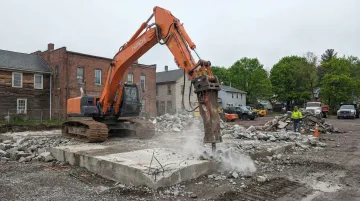
Not every job needs a full-service contractor, though. For Sullivan County and Hudson Valley contractors who want more control over costs, renting demolition equipment directly from a local heavy equipment provider like Rossini Equipment Corp is a practical middle ground.
Equipment such as excavators or breaker attachments can be rented with or without an operator. Opting for an operator means the job gets done with the right machine for the conditions—keeping the project on schedule and within budget without the overhead of a full-service demolition company.
How to Reduce Your Concrete Slab Removal Costs
Most Impactful Ways to Lower Overall Cost
Clear furniture, fencing, or obstacles before the crew arrives so equipment can reach the slab directly. Some contractors charge extra for difficult access — removing barriers in advance can save $1–$3/sq ft.
Handle post-removal cleanup or landscaping yourself. Contractors often bundle site restoration into their bid, but if you're planning to install new pavement or landscaping anyway, doing the prep work yourself reduces labor charges.
Ask whether the contractor uses a concrete recycling program. Recycling facilities charge less than landfills — in many cases, dump fees drop by 50% or more, which comes directly off your total.
Get at least 3 quotes and read what each one actually covers. A $4/sq ft bid that includes hauling and dump fees can be cheaper than a $3/sq ft bid that doesn't.
Most Common Budgeting Mistakes
- Focusing only on the upfront price without accounting for disposal
- Ignoring permit requirements until after work begins
- Choosing the lowest bid without verifying whether it includes hauling and dump fees
- Over-specifying a project (for example, full slab removal when only partial removal or repair was needed)
The Repair vs. Remove Decision
For concrete with minor cracks under ¼ inch wide, resurfacing or filling costs $1–$5/sq ft — significantly less than full removal. Full removal makes sense for large structural cracks, heaving, crumbling edges, or where the slab must be replaced with a new pour or different surface.
Frequently Asked Questions
How much does it cost to remove concrete per square foot, and what does that mean for 100 or 1,000 sq ft slabs?
The standard rate is $2–$8 per square foot, resulting in roughly $200–$800 for 100 sq ft and $2,000–$8,000 for 1,000 sq ft. The final number depends on thickness, reinforcement, and site access.
What's the average cost to remove a 20x20 concrete slab?
A 20x20 slab (400 sq ft) typically costs $800–$3,200. Unreinforced slabs fall at the low end, while reinforced or thick slabs approach the higher range.
Is it expensive to remove a concrete slab?
For most residential jobs, expect $500–$2,500 for a standard unreinforced slab. Reinforced slabs or those over 6 inches thick can push costs to $4,000–$8,000+. Thickness, rebar, and haul-off distance are the biggest price drivers.
How much does it cost to demo and haul off concrete?
Most contractor quotes bundle demolition and hauling together at $2–$8/sq ft. When priced separately, disposal/haul-off typically runs $50–$100 per ton. Property owners can reduce this cost by using concrete recycling programs.
How much does it cost to demo concrete stairs?
Concrete stair removal typically costs $250–$650 depending on whether the stairs are solid concrete or hollow forms. Solid stairs weigh considerably more and may require heavier equipment to lift and haul.
How much does it cost to remove a concrete wall, block wall, or retaining wall?
Standard concrete or block wall removal typically runs $850–$1,650. Retaining walls cost more — usually $1,500–$2,500+ — because backfill soil must also be excavated and hauled, adding both labor and disposal costs.