Introduction
Backfill the wrong way and you're looking at uneven settlement, foundation cracks, and water infiltration that can compromise everything built above it. Foundation backfill—filling and compacting the excavated space around a completed foundation—is one of the steps most likely to be underbudgeted and rushed.
Material selection, compaction method, and site conditions all affect what you'll pay — sometimes dramatically. This guide covers:
- Typical backfill cost ranges for 2026
- The factors that push prices up or down
- A straightforward volume calculation method
- How to build an accurate budget and avoid over-excavating
TL;DR
- Foundation backfill typically costs $12–$30 per cubic yard (material + labor + equipment), with total project estimates ranging from $2,000 to $8,000 depending on foundation size
- Biggest cost drivers: material type (clean fill vs. crushed stone), backfill volume, compaction requirements, and site access
- Lower-end pricing applies to small, shallow foundations with good site access using native fill
- Higher-end pricing covers deep basements, difficult terrain, or engineered fill requirements
- Skipping compaction or using unsuitable fill (expansive clay, organic debris) leads to settlement damage and costly foundation repairs
How Much Does Foundation Backfill Cost?
Foundation backfill does not have a single fixed price. Costs vary based on project size, material selection, labor rates, equipment needs, and site conditions. The Northeast region averages $12.50 per cubic yard for excavation and fill work — the highest nationally — due to challenging subsurface conditions and elevated labor costs.
Misjudging these variables leads to underbudgeting or structural problems later in the project.
Costs break into three tiers based on project scope and material choice. Each range typically covers material delivery, labor, and compaction; most exclude permits, drainage systems, and landscaping restoration.
Budget Range: Small Residential Projects ($2,000–$3,500)
Small projects — a garage, shed, or minor addition with shallow excavation — typically cover:
- Native or clean fill dirt (5–15 cubic yards)
- Basic labor for material placement
- Minimal equipment (small excavator or skid steer)
- Light compaction with a plate compactor
Best for homeowners with shallow foundations (3–4 feet deep), good site access, and stable native soil that can be reused.
Mid-Range: Standard Residential or Light Commercial ($4,000–$6,500)
Full basement and deep foundation projects on standard residential builds typically include:
- Gravel or engineered fill (15–30 cubic yards)
- Multiple lift placement (8–12 inch layers)
- Compaction equipment rental (plate compactor or jumping jack)
- Moderate labor hours (8–16 hours)
- Material delivery
Best for contractors and builders on standard residential construction with moderate depth (6–8 feet) and normal soil conditions.
High-End: Large, Deep, or Complex Foundations ($7,000–$12,000+)
Large or complex backfill projects carry higher costs due to volume, equipment, and site challenges. Scope typically includes:
- Premium engineered structural fill (30–60+ cubic yards)
- Extensive compaction with multiple equipment types
- Difficult site access surcharges (steep grades, tight access)
- Drainage layer installation (crushed stone against foundation wall)
- Specialized equipment (excavator with operator)
- Compaction testing and verification
Best for commercial foundations, deep basements (9+ feet), hillside builds, or sites with poor native soil requiring imported engineered fill.
Key Factors That Affect the Cost of Foundation Backfill
Pricing depends on technical, site-specific, and logistical variables. Understanding these helps avoid cost surprises and ensures the backfill protects your foundation investment.
Material Type and Quality
Material choice drives more price variation than any other single factor:
| Material Type | Cost per Cubic Yard | Key Features | |--------------|---------------------|--------------|\n| Native Soil (reused) | $0–$5 | Free if suitable; must be free of organics, clay, debris | | Clean Fill Dirt | $12–$20 | Screened, debris-free; reliable for stable sites | | Subsoil Fill | $8–$15 | Economical; lacks organic matter; basic leveling | | Crushed Stone/Gravel | $40–$50 | Premium drainage; compacts well; structural stability | | Engineered Structural Fill | $15–$30 | Specified gradation; high compaction; code-compliant |
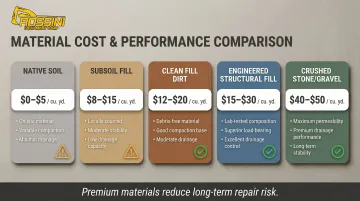
Native soil is cheapest, but building codes strictly prohibit organic material, wood forms, and construction debris — they decompose underground and create voids that cause settlement.
Highly plastic clays (Plasticity Index > 15) absorb moisture and exert lateral swell pressure against basement walls. On sites with expansive soils or poor drainage, crushed stone or engineered fill isn't optional — it's what keeps the wall standing.
Foundation Depth and Backfill Volume
Deeper foundations require more cubic yards of material, more labor hours, and more compaction passes.
Volume Calculation Formula: Length (ft) × Width (ft) × Depth (ft) ÷ 27 = Cubic Yards
Example: A foundation with 120 linear feet of perimeter, 3-foot trench width, and 8-foot depth:
- 120 ft × 3 ft × 8 ft = 2,880 cubic feet
- 2,880 ÷ 27 = 106.7 cubic yards
Simple Cost Estimate:
- 107 cubic yards × $20/yard (clean fill) = $2,140 (material only)
- Add labor ($1,500–$2,500) and equipment ($800–$1,200)
- Total: $4,440–$5,840
Important: Account for swell and shrink factors. Excavated material expands when removed but shrinks when compacted—one cubic yard of earth in a cut may occupy only 0.65 to 0.85 cubic yards in an embankment (15% shrink to 5% swell).
Compaction Requirements
Backfill must be placed in lifts (typically 8–12 inch layers) and compacted with a plate compactor or jumping jack. Building codes require lifts not exceeding 12 inches before each compaction pass. Skipping compaction allows voids to form, leading to settlement and wall cracking over time.
Minimum Compaction Standards:
- General backfill: 90% of maximum density (Modified Proctor, ASTM D1557)
- Subgrade areas: 95% of maximum density
- NY State DOT fill around structures: 95% of Standard Proctor Maximum Density
Compaction Equipment Costs:
- Plate compactor rental: $80–$120 per day
- Jumping jack tamper rental: $60–$90 per day
- Operator fee (if hiring equipment with operator): $50–$75 per hour
Some projects require compaction testing, which adds $300–$600 per test to verify density standards are met.
Site Access and Terrain
Tight site access, steep grades, or underground utilities limit equipment mobility and increase labor time. Estimators apply an efficiency factor between 50% to 83% to account for site conditions and access limitations.
Typical Surcharges for Difficult Access:
- Tight access requiring smaller equipment: +15–25%
- Steep slopes or hillside sites: +20–30%
- Underground utility congestion: +10–20%
- Limited staging area for materials: +10–15%
Equipment Productivity Impact: Small excavators (1–5 tons) move 10–20 cubic meters per hour, whereas medium excavators (6–10 tons) handle 20–40 cubic meters per hour. Restricted access forces use of smaller equipment, extending project duration and labor costs.
Site Location and Regional Labor Rates
Labor rates for backfill work vary by region. The Northeast—particularly the New York metro area and Hudson Valley—runs notably higher than rural areas, and that gap shows up directly in contractor bids.
New York State Labor Rates (2023–2025):
- Construction laborers in New York State: $28.50/hour ($59,280 annually)
- Construction laborers in NY-Newark-Jersey City metro: $30.93/hour ($64,330 annually)
- Operating engineers in New York State: $40.80/hour ($84,860 annually)
- Operating engineers in NY-Newark-Jersey City metro: $45.96/hour ($95,600 annually)
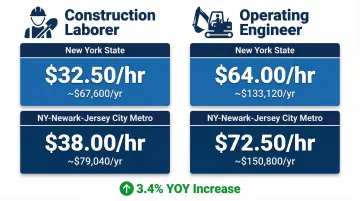
Compensation costs increased 3.4% year-over-year ending December 2025 in the New York metro area.
Permit Requirements: Some jurisdictions require permits for significant backfill work, particularly when importing more than 50 cubic yards or altering drainage patterns. Check with your local building department.
Foundation Backfill Cost Breakdown
Total backfill cost goes beyond material price. Several distinct line items make up the final invoice.
Material Cost
The cost of purchasing and delivering fill material varies by type and quantity in cubic yards. Typically the largest single cost on the invoice.
- Native fill (if suitable for reuse): $0–$5/yard
- Clean fill dirt: $12–$20/yard
- Crushed stone/gravel: $40–$50/yard
- Engineered structural fill: $15–$30/yard
Delivery fees typically add $100–$300 depending on distance and load size.
Labor for Placement
Hourly labor to place material in lifts around the foundation walls. Based on New York State rates, expect $28–$46 per hour for laborers, or $41–$50 per hour for skilled operators.
Typical labor hours for standard residential foundation (30 cubic yards):
- 8–12 hours for placement
- 4–6 hours for compaction
- Total: 12–18 hours ($336–$900)
Operator-included equipment rental (excavator with operator) may replace or supplement this line item.
Equipment (Excavator/Loader and Compaction Equipment)
Cost of renting or hiring an excavator or skid steer for material placement, plus a compactor for lift consolidation.
Rental Rates:
- Small excavator (8–10 ton): $300–$600/day
- Medium excavator (15–20 ton): $600–$900/day
- Skid steer loader: $250–$400/day
- Plate compactor: $80–$120/day
- Jumping jack tamper: $60–$90/day
Operators typically add $50–$75 per hour but eliminate the learning curve and reduce project risk. Rossini Equipment Corp. in Sullivan County, NY rents excavators and skid steers with experienced operators who handle placement and compaction directly, keeping projects on schedule.
Soil Disposal (If Native Soil Is Not Reused)
If excavated native soil was hauled away or is unsuitable for reuse, imported fill must be purchased and delivered.
Northeast Disposal Costs:
- Sullivan County, NY: $150 per ton tipping fee
- Ulster County, NY: $150 per ton ($20 minimum per load)
- Orange County, NY: $135.15 per ton
Soil weighs 2,200–2,500 lbs per cubic yard. For 30 cubic yards of disposal: 30 yards × 1.1 tons/yard × $150/ton = $4,950 (disposal only, not including hauling labor).
Drainage Layer and Waterproofing Protection
IRC Section R405.1 mandates drains around concrete or masonry foundations that retain earth and enclose habitable spaces below grade. Many foundations require a drainage aggregate layer (crushed stone) against the foundation wall before backfilling to prevent hydrostatic pressure.
Drainage Layer Requirements:
- Gravel or crushed stone must extend at least 1 foot beyond the footing edge and 6 inches above the top of the footing
- Perforated pipes must be placed on at least 2 inches of washed gravel and covered with at least 6 inches of the same material
- Filter fabric required to prevent soil migration into drainage stone
These requirements add a predictable cost layer — budget accordingly before finalizing your fill estimate.
Cost Impact:
- Crushed stone for drainage layer: $40–$50/yard
- Filter fabric: $0.50–$1.50/sq ft
- Perforated drain pipe: $3–$6/linear foot
- Typical drainage layer addition: $800–$2,000
Exception: Drainage systems are not required for foundations built on well-drained Group I soils (gravels and sands).
Choosing the Right Backfill Material: Budget vs. Premium
The backfill material you choose affects far more than your immediate budget — it determines how your foundation drains, compacts, and performs over decades. Getting this decision wrong is one of the most common causes of avoidable foundation repair.
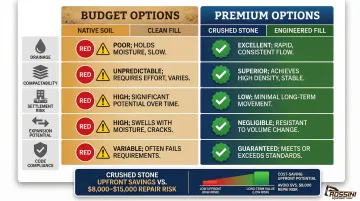
Performance Differences:
| Factor | Budget Options (Native Soil, Clean Fill) | Premium Options (Crushed Stone, Engineered Fill) |
|---|---|---|
| Drainage | Poor to medium; clays are practically impervious | Excellent; free-draining, reduces hydrostatic pressure |
| Compactability | Variable; clays difficult to compact uniformly | Consistent; angular particles lock together |
| Settlement Risk | Medium to high; organic content creates voids | Low; minimal compression under load |
| Expansion Potential | High for clays (can buckle walls) | Low; dimensionally stable |
| Code Compliance | Often requires testing/certification | Pre-engineered to meet specifications |
When Premium Fill Makes Financial Sense:
- Poor native soil conditions (high clay content, organic material)
- High water table requiring drainage management
- Codes requiring engineered fill (commercial projects, deep basements)
- Sites with history of settlement or unstable subgrade
- Hillside or sloped lots where lateral pressure is a concern
When Clean Fill Dirt Is Sufficient:
- Stable, well-draining sites with sandy or gravelly native soil
- Shallow foundations (4 feet or less)
- Non-structural backfill areas away from foundation walls
- Budget-constrained projects with verified soil suitability
Building codes back this up: highly plastic clays are strictly unsuitable for foundation backfill due to expansion risks, while clean gravels and sands meet drainage and compressibility requirements that clays cannot. Spending $1,200 more on crushed stone now typically prevents $8,000–$15,000 in foundation repair costs later.
How to Estimate Your Foundation Backfill Budget (and Avoid Common Mistakes)
Accurate budgeting requires calculating volume first, then applying realistic material and labor rates. Done right, this prevents the two most common budget killers: underestimating volume and over-excavating.
Step-by-Step Estimation Process
Step 1: Measure the Foundation Perimeter and Depth
- Measure total linear feet of foundation perimeter
- Determine average trench width (typically 2–4 feet)
- Measure excavation depth from top of footing to finish grade
Step 2: Calculate Total Cubic Footage
- Formula: Perimeter length (ft) × Average trench width (ft) × Depth (ft) = Cubic feet
- Convert to cubic yards: Cubic feet ÷ 27 = Cubic yards
Step 3: Multiply Cubic Yards by Material Cost
- Select material type based on site conditions and budget
- Multiply total cubic yards by cost per yard
Step 4: Add Labor, Equipment, and Delivery
- Labor: 12–18 hours × $28–$46/hour = $336–$828
- Equipment rental: $400–$1,200 (excavator + compactor for 2–3 days)
- Delivery: $100–$300
Worked Example:
- Foundation: 100 linear feet perimeter, 3-foot trench width, 7-foot depth
- Volume: 100 × 3 × 7 = 2,100 cubic feet ÷ 27 = 77.8 cubic yards
- Material: 78 yards × $18/yard (clean fill) = $1,404
- Labor: 15 hours × $35/hour = $525
- Equipment: $800
- Delivery: $200
- Total Estimate: $2,929
Common Mistakes That Inflate Costs
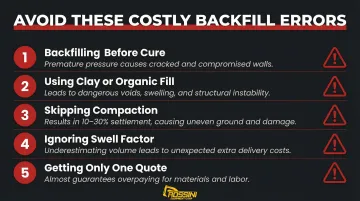
Backfilling before concrete cures. Per IRC 2024 requirements, backfill cannot be placed against a foundation wall until it has sufficient strength and is anchored to the floor above — typically after 7 days above 50°F. Premature backfill cracks or shifts walls, and repairs cost far more than waiting.
Using expansive clay or organic material. Organic material, construction debris, and highly plastic clays are prohibited because they decompose or swell over time, creating voids and lateral pressure. If unsuitable material has to be dug out and replaced after the fact, you're essentially paying for the job twice.
Skipping compaction. Uncompacted backfill settles 10–30% over time — enough to cause foundation movement, cracked walls, and drainage failures. The lift-and-compact method adds time upfront but eliminates far costlier problems later.
Ignoring material swell factor. Excavated material expands 10–35% when removed. Order fill based on compacted volume, not loose volume. Under-ordering mid-project means extra delivery fees and scheduling delays.
Getting only one quote. Prices vary more than most people expect — not just on materials, but on what's actually included. Get two or three quotes and confirm whether each covers material, delivery, labor, and compaction before comparing numbers.
Conclusion
Foundation backfill cost varies based on material type, project volume, soil conditions, and local labor rates. Getting those variables right — the right material, proper compaction, and an experienced operator behind the equipment — is what separates a foundation that holds for decades from one that causes problems down the road.
For contractors, builders, and property owners in Sullivan County, the Hudson Valley, and surrounding areas, Rossini Equipment Corp. provides equipment rentals and operator hire services rooted in a family construction legacy going back to 1963. Call (845) 794-1066 or email office@rossiniequipmentcorp.com to discuss equipment and site work support that keeps your project on schedule and within budget.
Frequently Asked Questions
How much does backfilling cost?
Foundation backfilling typically costs $12–$30 per cubic yard for combined material and labor, with total project costs ranging from $2,000 to $12,000. Final cost depends on backfill volume, material type (clean fill vs. crushed stone), compaction requirements, and site access conditions.
When can you backfill a foundation?
You must wait a minimum of 7 days after pouring concrete before backfilling to allow adequate cure strength, per ACI 308.1 standards. Backfill shall not be placed until the foundation wall has sufficient strength and has been anchored to the floor above or sufficiently braced. Backfilling too early can crack or shift walls, causing structural damage.
How long does it take to backfill a foundation?
Most residential foundation backfill projects take 1–2 days after the mandatory 7-day concrete cure period. The timeframe depends on foundation perimeter size, excavation depth, and number of compaction lifts required. Larger or deeper foundations with extensive compaction testing may take 3–4 days.
What is the best way to backfill a foundation?
The industry-standard approach is the layered lift-and-compact method: place material in 8–12 inch lifts and compact each layer with a plate compactor or jumping jack before adding the next. Per 2024 BCNYS code, each lift must be compacted before the next is added to ensure adequate density and prevent future settlement.
What is the best backfill for foundation?
Crushed stone or clean gravel is the go-to choice for foundation backfill — both drain well, compact reliably, and minimize settlement and hydrostatic pressure risks. Clean fill dirt works on well-draining sites with stable Group I soils (sandy or gravelly native material), but never use highly plastic clays or organic material; both are code-prohibited.