
Introduction
A leftover tree stump is more than an eyesore. It attracts pests like termites and carpenter ants, creates trip hazards for children and visitors, and interferes with landscaping plans, lawn maintenance, and future construction projects. In 2026, stump removal costs range widely—from $150 for a small grinding job to over $700 for full excavation of a large hardwood stump with complex roots.
This guide breaks down 2026 pricing ranges, the main cost factors, the difference between grinding and full removal, and practical ways to lower your cost—whether you're a homeowner with one stump or a contractor clearing an entire site in Sullivan County or the Hudson Valley.
TLDR
- Stump removal typically costs $150–$700 per stump in 2026, with most homeowners paying $200–$400
- Size (diameter), removal method, root complexity, and site accessibility drive the price
- Grinding is cheaper and faster — full removal costs more but eliminates roots entirely
- Multiple stumps on one visit lower the per-stump rate to $40–$75 each
- Off-season scheduling and doing your own site prep are the easiest ways to cut costs
How Much Does Stump Removal Cost in 2026?
Stump removal does not have a fixed price. Costs depend on the method chosen, stump size, site conditions, and local labor rates. Without a clear estimate upfront, it's easy to choose the wrong method — or pay for more removal than the job actually requires.
The national average for stump removal is $369, with typical residential projects ranging from $195 to $609. Most professionals charge $2–$5 per diameter inch, measured at the stump's widest point at ground level. However, nearly all contractors apply a minimum call-out fee of $100–$150 to cover travel, equipment transport, and setup, even for small stumps.
Stump Removal Cost by Method
The four main removal methods have very different cost ranges and timelines:
| Removal Method | Average Cost Range | Time on Site | Root Status | Best Use Case |
|---|---|---|---|---|
| Stump Grinding | $150–$500 | 1–2 hours | Left to decompose | Lawn restoration, general landscaping |
| Full Manual Removal | $200–$700 | 2–4+ hours | Completely removed | Construction, hardscaping, replanting |
| Chemical Rotting | $60–$200 | Weeks to months | Left to decompose | DIY budget projects with no time constraints |
| Stump Burning | $100–$200 | Hours to days | Partially removed | Rural areas with low fire risk and legal permits |
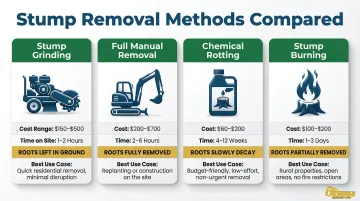
The key trade-off across methods: grinding and chemical rotting leave roots to decay underground, while manual removal is the only option that eliminates the entire root ball — critical for construction, hardscaping, or replanting. Burning is fast but restricted in most municipalities; check local ordinances before considering it.
Stump Removal Cost by Size
Stump diameter drives the per-job price. Smaller stumps typically fall under the minimum call-out fee, while larger stumps increase costs due to additional grinding passes and equipment time.
| Stump Diameter | Estimated Cost Range | Notes |
|---|---|---|
| Up to 12 inches | $100–$150 | Usually falls under minimum fee |
| 18 inches | $100–$150 | Often triggers minimum call-out fee |
| 24 inches | $120–$200 | Standard mid-sized stump pricing |
| 36 inches | $180–$300 | Requires more grinding passes and time |
| 48 inches | $240–$400 | Heavy equipment required; longer time on site |
| 60+ inches | $300–$700+ | Massive root flares increase surface area exponentially |
Critical cost-saving tip: Removing multiple stumps in a single visit brings the per-stump rate down dramatically — typically to $40–$75 per additional stump after the first. Address all stumps in one visit whenever possible.
Key Factors That Affect the Cost of Stump Removal
Final pricing reflects a combination of technical, physical, and operational variables — stump size, species, soil conditions, site access, and location all factor in before a contractor sets a number.
Stump Size, Species, and Root Complexity
Diameter is the primary pricing factor, but tree species matters too. Hardwoods like oak, maple, elm, and walnut have denser wood and deeper root systems that add time and wear to equipment. Grinding hardwood stumps typically adds $50–$150 to the base cost compared to softwoods like pine, which process faster.
Root complexity can substantially increase job duration and cost. Sprawling lateral roots, surface roots, or roots that have intruded into foundations, drainage lines, or utility corridors require extra caution and manual labor. Root removal as a standalone task typically adds $100–$200 per hour beyond the base stump quote.
Site Conditions: Soil, Terrain, and Accessibility
Soil type affects grinding efficiency and equipment wear:
- Rocky or compacted soil (common in the Catskills and Hudson Valley) can dull or damage grinding equipment, prompting contractors to increase rates or bring in additional machinery
- Sandy or loamy soil is easier to work and tends to cost less
- In glacial till areas, grinding in rocky soil can increase costs by 50% or more
Poor site accessibility adds labor time and cost:
- Stumps on hillsides, in fenced yards, near structures, or in tight spaces require extra caution and maneuvering time
- Difficult-access scenarios typically add $50–$200 to the base quote
- Contractors may need to use smaller, less efficient equipment to avoid property damage
Geographic Location and Number of Stumps
Geographic location affects pricing through local labor rates, permit requirements, and disposal costs:
- Urban and suburban markets like the greater New York metro area typically run 15–30% higher than rural areas
- In smaller markets like Sullivan County or the Hudson Valley, rates may be more moderate but vary by company
- Remote rural locations may trigger travel fees of $50–$200 or $0.50 per mile to reach your property
How Stump Count Affects Your Total
The number of stumps on your property directly affects total cost. The first stump carries the full mobilization cost — equipment transport, setup, and crew travel. Each additional stump in the same visit costs less because equipment and crew are already on-site. Bundling multiple stumps in one visit can cut your per-stump cost by 50% or more.
Stump Grinding vs. Full Stump Removal: What's the Real Cost Difference?
This is the most common decision property owners face, and the right choice depends on the end use of the cleared space—not just the upfront price.
What Stump Grinding Covers
Stump grinding uses a motorized grinder to shred the stump 4–6 inches below grade, leaving the root system to decompose underground. It is the faster, less invasive, and more affordable method—typically costing $150–$500—and is sufficient for most residential cleanups, lawn improvement projects, and aesthetic purposes.
Key advantages:
- Completed in 1–2 hours for most stumps
- Minimal disruption to surrounding landscape
- Leave wood chips on-site as mulch
- No large excavation hole to fill
Key limitation: Because roots remain underground, grinding is not recommended when the area will be used for new construction, a patio or hardscape installation, or replanting a tree in the same spot. Decaying roots cause soil settling, tie up nitrogen, and can create sinkholes.
What Full Manual Removal Covers
When grinding won't do—before pouring concrete, grading a lot, or replanting in the same spot—full removal is the only viable option. It involves excavating around the trunk, severing lateral roots, and extracting the entire root ball, leaving a completely clear, root-free void. Costs range from $200–$700 depending on root depth and complexity.
Why it costs more:
- Takes 2–4+ hours depending on root complexity
- Generates more debris (soil, roots, and wood)
- Requires heavy equipment like an excavator or loader
- Leaves a large hole that requires topsoil fill
For contractors and site crews handling multiple removals, renting equipment is often more cost-effective than hiring a full-service tree crew. Rossini Equipment Corp. in Monticello, NY rents excavators and site prep equipment at flexible daily, weekly, and monthly rates, with or without an experienced operator.
What's Often Left Out of Your Stump Removal Quote
Many stump removal quotes cover only the grinding or extraction itself. Several common costs get billed separately, and knowing them upfront prevents surprises when the invoice arrives.
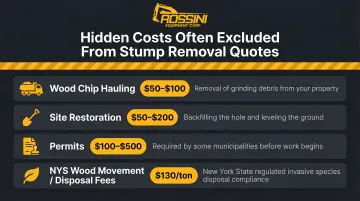
Here are the four costs most commonly excluded from base quotes:
- Wood chip hauling: Grinding a mid-sized stump generates 2–3 cubic yards of chips and sawdust. Full haul-away runs $1–$4 per diameter inch or a flat $50–$100. Some contractors will spread chips as mulch at no charge, but truck-off disposal is billed separately.
- Site restoration: The void left after removal needs topsoil fill ($50–$100) and, if the stump was in lawn area, grass seeding or sodding ($75–$200). Expect these as separate line items.
- Permits: Removing stumps near utility lines or burning them may require a municipal permit. Costs range from $100–$500 depending on the municipality. Confirm with local authorities before work starts to avoid delays or fines.
- NYS wood movement rules: New York State DEC restricts untreated wood movement to within 50 miles to limit the spread of Emerald Ash Borer and Spotted Lanternfly. If chips go to a municipal facility, Sullivan County charges $130 per ton for solid waste disposal. Repurposing chips as on-site mulch sidesteps both the transport restrictions and hauling fees.
Tips to Lower Your Stump Removal Costs
Get at least three quotes from local stump removal companies before committing. Quotes vary widely based on how companies assess root complexity and site difficulty. Ask whether debris removal, topsoil fill, and cleanup are included in the quoted price.
Bundle and schedule strategically:
- Remove multiple stumps in one visit to reduce per-stump rates dramatically
- Schedule in late fall or winter when demand for tree services drops — this often yields 10–20% lower rates
- Avoid emergency call-outs whenever possible; they carry premium pricing
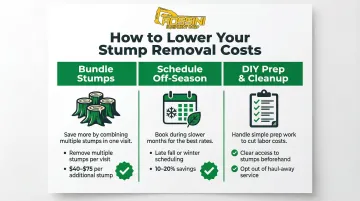
Handle prep and cleanup yourself:
- Clear obstacles, open fence panels for equipment access, and mark sprinkler heads before the crew arrives
- Rake back mulch around the stump base to reduce time spent on-site
- Opt out of debris haul-away by keeping chips as mulch or disposing of them yourself — this cuts costs significantly
Call 811 before any work begins to locate underground utility lines. Striking a water or gas line creates serious property damage and liability — a cost far exceeding any savings on the job.
Frequently Asked Questions
How much does stump removal service cost?
Stump removal typically costs $150–$700 per stump in 2026, with most homeowners paying $200–$400 for a standard job. The final price depends on stump size, removal method (grinding vs. full excavation), and site conditions like soil type and accessibility.
What factors affect stump removal service cost?
The primary drivers are stump diameter, removal method, root complexity, soil and site conditions, geographic location, and the number of stumps being removed. Hardwood species, rocky soil, and difficult access can each add $50–$200 to the base quote.
Is it cheaper to grind a stump or remove it?
Grinding is almost always cheaper ($150–$500 vs. $200–$700+ for full removal). However, full removal is worth the added cost when the site will be used for construction, hardscaping, or replanting, as decaying roots cause soil settling and structural issues.
When is the cheapest time of year to hire stump removal services?
Late fall and winter are the off-season for tree services, when demand drops and many companies offer lower rates or are more willing to negotiate—especially for multi-stump projects. Scheduling in February or March often brings 10–20% discounts off peak summer rates.
How long does stump grinding or removal take?
Stump grinding on a standard stump typically takes 1–2 hours, while full manual removal can take 2–4 hours or more depending on root complexity. Multiple stumps on the same visit extend the total time but usually not proportionally.
Is it okay to remove only the stump and leave the roots?
In most cases, yes—leaving roots to decompose naturally after grinding is fine for lawns and general landscaping. However, for construction, hardscape installation, or replanting in the same spot, full root removal is strongly recommended to avoid structural issues and nutrient imbalance that can hinder new plantings.