Introduction
Most contractors and property owners know they'll pay to move a machine, but few understand what drives the number they're quoted. Equipment hauling rates per mile aren't fixed tariffs — they're calculated based on trailer type, load specifications, distance, permits, and a range of operational factors that shift by job.
This article breaks down what the rate represents, what a realistic range looks like by trailer and load type, which factors move the number up or down, and how to estimate total hauling cost before requesting a quote.
TL;DR
- Hauling rates typically range from $2.00 to $10.00+ per mile depending on trailer type, load size, and distance
- Per-mile rate is only part of the cost—permits, fuel surcharges, escort vehicles, and load assistance fees all add up
- Short hauls (under 200–300 miles) often use a flat day rate rather than a per-mile rate
- Heavier, wider loads require more specialized trailers—and that drives the rate up
- Accurate quotes require exact weight, dimensions, pickup/delivery conditions, and your timeline
What Equipment Hauling Rates Per Mile Actually Measure
A per-mile rate is a blended operational cost figure that accounts for everything required to move a specific load safely and legally from origin to destination. It's not a simple distance charge—it's a calculated number built from several cost layers.
Two-Part Cost Structure
Most hauling quotes follow a two-part structure:
- Linehaul rate: The per-mile base charge for transportation
- Accessorial charges: Extra costs stacked on top, including fuel surcharges, permit fees, escort vehicles, and load assistance
When carriers quote a "per-mile rate," they're typically referring only to the linehaul portion. The accessorials can add 50% or more to the base rate.
Per-Mile vs. Day Rate Pricing
Hauling quotes use different pricing models based on distance:
- Per-mile rates: Used for hauls typically over 200–300 miles
- Day rates or flat fees: Used for short local hauls under this threshold
Short-distance moves often have higher effective per-mile costs when back-calculated, because fixed costs—mobilization, permits, driver time—are spread over fewer miles.
Why Equipment Hauling Costs More Than Standard Freight
Those pricing dynamics explain the structure, but not the premium. Equipment hauling carries higher base rates than standard freight because the loads require:
- Specialized trailers (lowboys, RGNs, stepdecks)
- More experienced drivers with specialized certifications
- State-by-state permitting and compliance
- Physical route surveys for oversize loads
Typical Equipment Hauling Rate Ranges by Trailer Type
Trailer selection is the single strongest predictor of per-mile cost. The type of trailer required is determined by the equipment's weight, height, and configuration.
Current Rate Benchmarks by Trailer Category
| Trailer Type | Cost Per Mile | Best For |
|---|---|---|
| Hot Shot | $1.50–$2.50 | Lighter loads, smaller equipment, urgent delivery |
| Standard Flatbed | $2.10–$3.50 | Mid-weight equipment, standard dimensions |
| Stepdeck / Drop Deck | $3.00–$3.50 | Taller equipment needing lower deck height |
| Lowboy / RGN (Legal) | $3.50–$8.00 | Heavy equipment within legal limits |
| Lowboy / RGN (Oversize) | $5.00–$15.00+ | Oversize or overweight loads requiring permits |
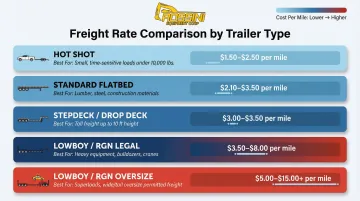
The wide rate gap between flatbeds and lowboys isn't arbitrary — the cost difference reflects real differences in equipment investment, insurance, and driver requirements.
Why Lowboy and RGN Trailers Cost More
Lowboy and RGN (Removable Gooseneck) trailers sit at the top of the rate range:
- Engineered for heavy, low-clearance equipment like excavators, bulldozers, and graders — no standard trailer can substitute
- Cost $80,000–$250,000+ per unit, versus $30,000–$50,000 for a flatbed
- Require heavy haul insurance that runs 2–3x higher than standard trucking coverage
- Carry $3,000–$8,000 in annual maintenance costs for hydraulic detach systems and multi-axle suspensions
- Demand specialized driver training, which commands a premium on pay
Oversize and Overweight Load Rates
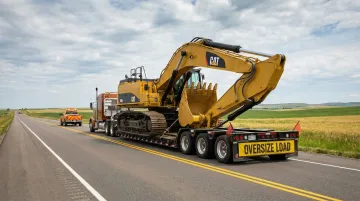
Once a load exceeds standard permit thresholds, the rate structure changes significantly. Federal regulations set maximum limits at:
- Weight: 80,000 lbs gross vehicle weight
- Width: 102 inches (8.5 feet)
- Axle limits: 20,000 lbs single axle, 34,000 lbs tandem axle
When equipment exceeds these thresholds, expect:
- Higher per-mile rates ($5.00–$15.00+)
- Additional escort vehicle requirements
- Multi-state permit fees
- Route surveys and travel time restrictions
Day Rates for Regional Hauls
For hauls under 200–300 miles, carriers typically quote day rates or flat fees rather than per-mile rates:
- Legal loads (under 100 miles): $300–$800
- Oversize loads (under 100 miles): $800–$2,500+
- Minimum dispatch charge: $300–$500 to cover fixed costs
For contractors and property owners moving equipment within Sullivan County or the Hudson Valley, day rates apply to most jobs — distances rarely exceed 100 miles, so knowing the flat-fee range matters more than the per-mile number.
Key Factors That Drive Equipment Hauling Costs Per Mile
Equipment weight, dimensions, permits, fuel surcharges, and haul distance all feed into the final per-mile rate. Knowing how each factor works lets you build a realistic budget before the trailer ever shows up.
Equipment Weight and Dimensions
Weight drives trailer selection and regulatory compliance. Heavier loads require more axles to distribute weight legally, and each additional axle adds equipment and labor cost. A standard 50-ton lowboy trailer has a tare weight of approximately 18,180 lbs — the trailer's own empty weight — which eats into usable payload before hitting the 80,000 lb federal gross limit.
Dimensions determine what permits you'll need:
- Height, width, and length each trigger specific permit thresholds
- Loads exceeding those thresholds require escort vehicles
- Carriers must reroute around low bridges or narrow roads, adding miles and time
Fuel and Fuel Surcharges
Fuel surcharges are a separate line item in most hauling quotes, tied to published diesel price indexes. The standard calculation is:
(Current EIA diesel price − Baseline price) ÷ MPG = Fuel Surcharge per mile
Oversize loads consume more fuel per mile than standard freight. FHWA research shows a 50% payload weight increase raises fuel consumption less than 7%, but aerodynamic drag from wide or tall loads drives fuel use up considerably.
Permits and Regulatory Compliance
Every state sets its own permit fees, travel-hour windows, and escort requirements for oversize or overweight loads. Multi-state hauls require compliance with each state's rules, stacking permit costs.
New York State Requirements:
New York DOT regulations set legal limits at:
- Weight: 80,000 lbs gross vehicle weight
- Width: 8'6"
- Height: 13'6"
- Length: 65' combination length
Permit Fees in New York:
- Single Trip permits: $40 plus $10 amendment fee
- Superload Trip permits: $40 plus $10 amendment fee
Those fees are low — but time restrictions add real scheduling pressure. New York State prohibits travel during 7:00 AM–9:00 AM and 4:00 PM–6:00 PM for loads exceeding:
- 16 feet in width
- 100 feet in length
- 14 feet in height
Escort Vehicles and Route Complexity
Pilot cars are legally required for loads that exceed certain width and height thresholds. New York State escort requirements include:
Front Escort Required:
- Width exceeds 12 feet on two-lane highways
- Length is 80 feet or greater
- Height is 14 feet or greater
- Overhang is greater than 10 feet
Police Escort Required:
- Width exceeds 16 feet on two-lane highways (18 feet on four-lane)
- Gross vehicle weight exceeds 200,000 lbs
- Height is 16 feet or greater
Escort Costs:
Pilot cars typically cost $1.50–$3.00 per mile, per vehicle. For a 350-mile haul requiring one escort vehicle, add $525–$1,050 to the total cost.
Route complexity—narrow roads, low bridges, urban corridors—can require alternate routing that adds miles and time, further increasing costs.
Distance and the Short Haul Effect
There's an inverse relationship between distance and per-mile rate: fixed costs (mobilization, permits, driver time) are spread over fewer miles on short hauls, making the effective per-mile cost higher.
Example:
- 200-mile move: Might cost $5.00/mile ($1,000 total)
- 1,000-mile move: Might cost $3.50/mile ($3,500 total)
This is particularly relevant for regional equipment moves in Sullivan County and the Hudson Valley, where hauls are often under 100 miles. For these distances, a day rate becomes the more appropriate pricing model.
How to Calculate Your Total Equipment Hauling Cost
Use this step-by-step framework to estimate total hauling cost:
Basic Cost Formula:
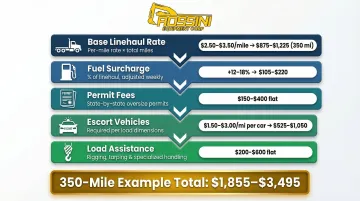
(Linehaul rate per mile × Total miles) + Fuel surcharge + Permit fees + Escort costs + Load assistance = Estimated total
Step-by-Step Estimation Process
Step 1: Gather Equipment Specifications
Before requesting a quote, collect:
- Operating weight (not listed capacity)
- Height with attachments or blade/bucket in travel position
- Width at the widest point — tracks, tires, or any overhang
- Total length including extensions
- Site access at both ends: paved or unpaved? Room to position a lowboy?
Step 2: Identify Required Trailer Type
Based on weight and dimensions, determine which trailer category applies (see rate table above).
Steps 3–7: Build Your Cost Stack
Once you have the trailer type and distance, layer in each cost component:
| Cost Component | Typical Rate | 350-Mile Example |
|---|---|---|
| Base linehaul | Per-mile rate × miles | $3.75/mile = $1,312.50 |
| Fuel surcharge | $0.30–$0.50/mile | $105–$175 |
| Permit fees | Per state crossed | ~$200–$300 (2 states) |
| Escort vehicles | $1.50–$3.00/mile per vehicle | Varies by load width |
| Load assistance | $100–$500 flat | Only if carrier loads/unloads |
Real-World Cost Examples
Regional Move (45,000 lb Excavator, 350 miles):
- Base linehaul: $1,312.50 ($3.75/mile)
- Fuel surcharge: $157.50
- Permits (2 states): $275
- Escort (1 vehicle): $612.50
- Total: $2,357.50
Interstate Haul (Overweight, 500 miles):
- Base linehaul: $3,500 ($7.00/mile)
- Fuel surcharge: $350
- Permits (3 states): $450
- Escort (1 vehicle): $1,000
- Total: $5,300
Working with In-House Transportation Teams
These numbers only hold up when the hauler quoting the job is the one actually executing it. Freight brokers add a middleman layer — meaning the rate you're quoted and the crew that shows up can be two entirely different arrangements.
Rossini Equipment Corp. handles equipment delivery and pickup with an in-house transportation team. The same people pricing the haul are the ones loading and moving the machine, which keeps quotes accurate and removes the coordination breakdowns that tend to inflate final costs.
Common Misconceptions About Equipment Hauling Rates Per Mile
Misconception 1: The Quoted Per-Mile Rate Is the Total Cost
The linehaul rate is just the starting point. Fuel surcharges, permit fees, and escort costs stack on top — and they add up fast. Here's a real-world breakdown:
- Base rate quote: $3.50/mile for 400 miles = $1,400
- Fuel surcharge: $160
- Permits: $300
- Escort: $800
- Actual total: $2,660 (90% higher than the base rate alone)
Misconception 2: Longer Hauls Are Always More Expensive
Total cost does increase with distance, but the per-mile rate on long hauls is typically lower than on short hauls — fixed costs spread over more miles, which brings the rate down.
A 500-mile haul may cost less per mile ($3.50/mile = $1,750) than a 50-mile haul quoted at a $500 day rate (effective rate: $10.00/mile).
Misconception 3: Any Lowboy or Flatbed Carrier Can Haul Oversize Construction Equipment
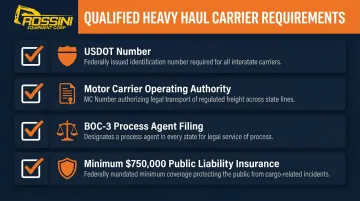
Moving machines above permit thresholds requires carriers with appropriate FMCSA authority, active permits, and hands-on experience navigating state-specific compliance rules. A qualified carrier must have:
- A USDOT Number for interstate commerce
- Motor Carrier (MC) Operating Authority through the Unified Registration System
- A BOC-3 Process Agent Filing designating legal agents in each operating state
- Minimum $750,000 in public liability insurance for vehicles over 10,000 lbs GVWR
Selecting the wrong carrier creates real risk — legal exposure, delivery delays, and potential equipment damage.
Frequently Asked Questions
What are typical equipment hauling rates per mile?
Typical equipment hauling rates range from $1.50–$2.50/mile for hot shot trailers, $2.10–$3.50/mile for standard flatbeds, and $3.50–$8.00/mile for lowboy/RGN trailers with legal loads. Oversize loads push rates to $5.00–$15.00+/mile. Fuel surcharges, permit fees, and escort costs are added on top of the base rate.
How much does lowboy hauling cost per mile?
Lowboy and RGN trailer hauling typically costs $3.50–$8.00 per mile for legal loads—more than standard flatbeds due to specialized equipment, higher insurance, and driver expertise requirements. Overweight or oversize configurations push the rate to $5.00–$15.00+/mile.
How much does it cost to transport heavy equipment, like an excavator?
For a regional move under 100 miles, expect $800–$2,500 for an oversize excavator. Longer interstate hauls (350+ miles) typically run $2,000–$5,000+, depending on the machine's weight, configuration, and permit or escort requirements.
How do I calculate equipment hauling rates per mile?
Use this formula: (Base linehaul rate × miles) + fuel surcharge + permit fees + escort costs + load assistance. Accurate inputs are essential—provide exact equipment weight, dimensions (height with attachments, width, length), pickup/delivery site conditions, and timeline to get a reliable estimate.
How much weight can a 50-ton lowboy haul?
Despite a rated capacity near 100,000 lbs, practical highway payload is roughly 50,000–60,000 lbs once trailer and tractor weight are subtracted from the 80,000 lb federal GVW limit. Multi-axle configurations can carry heavier loads by distributing weight across additional axles.
What is a day rate for equipment hauling and when does it apply?
A day rate is a flat fee—rather than a per-mile charge—used for short hauls typically under 200–300 miles. Rates range from $300–$800 for legal loads and $800–$2,500+ for oversize moves, covering driver time and equipment mobilization. It's the standard billing structure for local and regional hauls where fixed costs don't shrink proportionally with distance.
Need reliable equipment hauling in Sullivan County or the Hudson Valley? Rossini Equipment Corp.'s in-house transportation team handles delivery and pickup directly, providing accurate quotes and experienced execution. Call (845) 794-1066 or email office@rossiniequipmentcorp.com to discuss your hauling needs.