
Introduction
Excavators are the backbone of modern construction, accounting for over 51% of the global construction equipment market. But choosing the wrong brand or machine can stall a project, inflate costs, or create serious safety risks on the job site. A compact excavator that's too small for foundation work means rework and delays. A large crawler without adequate dealer support in your region means extended downtime when parts are needed.
The excavator market spans dozens of global manufacturers, each with different strengths in machine size, technology, and application type. Caterpillar dominates with dealer density. Komatsu leads in factory-integrated machine control. Volvo is pushing electric models.
Knowing these distinctions matters for contractors, builders, and property owners who need equipment that matches their specific job requirements.
This guide breaks down the top excavator manufacturing companies, what sets each apart, and what to look for when selecting the right equipment for your project.
TL;DR
- Caterpillar, Komatsu, John Deere, and Volvo are the most widely used excavator manufacturers in North American construction
- Matching the right brand to your application — not just buying the biggest name — directly affects productivity and long-term costs
- Mini excavators from brands like Bobcat are increasingly popular for tight urban and landscaping projects
- Key selection criteria include digging depth, operating weight, and total cost of ownership
- Working with a reputable rental provider gives you access to well-maintained machines without the capital commitment of ownership
What Is an Excavator and Why Manufacturer Choice Matters
Excavators are hydraulic machines designed for digging, grading, demolition, and material handling. Core types include mini/compact (under 6 tons), mid-size crawler (6–30 tons), large crawler (30+ tons), and wheel excavators for paved surfaces.
Manufacturer choice affects far more than brand loyalty. It directly impacts:
- How often the machine goes down — and how long it stays down
- Whether replacement parts are stocked locally or take weeks to ship
- How close the nearest dealer is when you need field support
- Fuel burn rates and total operating cost per hour
- Cab comfort and controls — which affects operator fatigue on long shifts
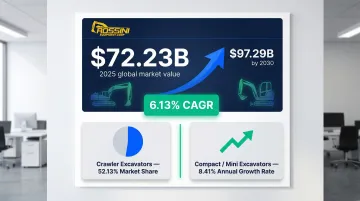
Those factors also reflect a market in serious motion. According to industry research, the global excavator market was valued at $72.23 billion in 2025 and is projected to reach $97.29 billion by 2030, growing at 6.13% annually. Crawler excavators hold 52.13% of market share, while compact and mini excavators are growing at 8.41% per year — driven largely by urban infrastructure work where tight spaces demand smaller machines. More manufacturers competing for that growth means more options, but also more variation in quality and support.
Top Excavator Manufacturing Companies
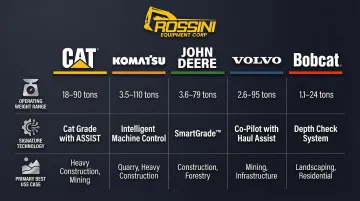
These five manufacturers represent the most widely recognized names in North American construction. Each profile below covers model range, signature technology, and best-use cases — the three factors that most affect which brand fits a given project type.
Caterpillar (CAT)
Caterpillar is the world's largest construction equipment manufacturer, headquartered in Irving, Texas since 2022. The company offers over 50 excavator models spanning from 2,399-lb mini units to 207,400-lb large crawlers.
Cat's most significant advantage is its dealer and parts network — 160 independent dealers serving 197 countries — which keeps parts accessible and machines running on tight schedules.
On the technology side, Cat Grade provides factory-integrated 2D and 3D machine control, and Cat Product Link telematics enables remote monitoring and diagnostics. Together, these systems help reduce downtime and retain strong resale value.
| Attribute | Details |
|---|---|
| Key Model Range | Mini to large crawlers, wheel excavators, demolition, and long-reach models; 13 HP (300.9D mini) to 542 HP (395 large) |
| Signature Technology | Cat Grade with 2D/3D machine control, Cat Product Link telematics, semi-autonomous features on newer models |
| Best Use Cases | Foundation excavation, large-scale site work, road construction, and demolition across all project scales |
Komatsu
Founded in 1921 and headquartered in Japan, Komatsu is the second-largest construction equipment manufacturer globally. The company offers 50+ excavator models from compact units to mining-class machines widely used in U.S. construction and infrastructure.
Komatsu's standout feature is Intelligent Machine Control (iMC) — factory-integrated GPS and blade control that reduces staking and grade checking on site. The KOMTRAX telematics system provides remote equipment monitoring. The Komatsu CARE program offers complimentary scheduled maintenance for the first three years or 2,000 hours, significantly reducing total operating cost.
| Attribute | Details |
|---|---|
| Key Model Range | Small, mid-size, large crawler, and surface mining excavators; 6,812 lbs (PC30MR-5) to over 773 tons (PC8000-11) |
| Signature Technology | Intelligent Machine Control (iMC), KOMTRAX telematics, hybrid hydraulic systems on select models |
| Best Use Cases | Infrastructure and road projects, mining operations, and grading-intensive site preparation work |
John Deere
John Deere manufactures excavators in Kernersville, North Carolina, and Indaiatuba, Brazil. The company offers 26 excavator models from compact 17 P-Tier units to large 670 P-Tier machines, using a "Performance Tiering" naming convention (G, P, and X tiers) to denote feature levels.
John Deere's strengths include JDLink telematics for remote fleet management and a strong dealer network across rural and suburban U.S. markets. The company offers a standard 2-year/2,000-hour warranty on most models.
| Attribute | Details |
|---|---|
| Key Model Range | Compact, mid-size, and large crawlers; 3,920 lbs (17 P-Tier) to 154,103 lbs (670 P-Tier) |
| Signature Technology | JDLink telematics, SmartGrade integrated grade control, John Deere WorkSight fleet management |
| Best Use Cases | Residential site prep, utility trenching, grading, and general excavation on mid-size to large projects |
Volvo Construction Equipment
Volvo CE originates from Sweden with a 190+ year engineering heritage, offering 38 excavator models ranging from the ECR18E (3,748 lbs) to the EC950F (209,020 lbs). Volvo leads the industry in electric and hybrid construction equipment availability.
The company backs its machines with an industry-leading warranty: 2-year parts coverage plus a Lifetime Frame and Structure Warranty on the frame, boom, and arm for the initial owner.
Volvo also offers the broadest commercial availability of electric excavators in North America — including the ECR25 Electric and EC230 Electric — and its Co-Pilot display gives operators real-time load and efficiency data on the job site.
| Attribute | Details |
|---|---|
| Key Model Range | Compact, wheel, and crawler (medium and large); 3,748 lbs to 209,020 lbs; 38 total models |
| Signature Technology | Volvo Co-Pilot display, Dig Assist and Load Assist systems, battery-electric compact excavators |
| Best Use Cases | Urban site work, environmentally sensitive projects, and contractors seeking low total cost of ownership |
Bobcat
Bobcat is the leading compact excavator brand in North America, operating within the Doosan Group with independent operations. The company offers 17 models from the E10 (2,593 lbs) to the E165 (38,376 lbs), with Zero Tail Swing (ZTS) and Minimal Tail Swing configurations designed for confined job sites.
Key differentiators include wide attachment compatibility across the compact line, North American assembly in Gwinner and Bismarck, North Dakota, and a standard 2-year/2,000-hour warranty. These features make Bobcat a go-to for landscapers, utility contractors, and property owners who need maneuverability without sacrificing capability.
| Attribute | Details |
|---|---|
| Key Model Range | Compact excavators from 2,593 lbs (E10) to 38,376 lbs (E165); 17 total models, including zero-swing designs |
| Signature Technology | Selectable joystick controls, Bobcat MAX-2 frame protection, broad quick-attach compatibility |
| Best Use Cases | Landscaping, utility work, residential excavation, and any project in tight or confined job site conditions |
What Sets the Best Excavator Manufacturers Apart
Warranty depth and dealer network density are the two most overlooked differentiators. A manufacturer with strong local dealer coverage means faster parts availability and reduced downtime on active job sites.
Challenger brands are disrupting the market with aggressive warranty terms:
- Link-Belt: 5-year/5,000-hour full machine warranty (requires Fluid Analysis Program)
- SANY America: 5-year/5,000-hour full machine warranty (parts and labor)
- XCMG: 5-year/5,000-hour structural components warranty
That's a significant advantage over the standard 1-to-2 year terms offered by many legacy OEMs — and a real incentive for contractors evaluating total cost of ownership.
Technology integration now separates premium manufacturers from the pack. Modern excavators ship with telematics, GPS machine control, and semi-autonomous grading systems built in — not bolted on as afterthoughts. For contractors working to tight grade tolerances, factory-integrated systems like Komatsu's iMC or Cat Grade directly reduce rework and keep projects on spec.
Electric and hybrid models matter most for contractors in urban environments or on sustainability-focused projects. Current production options include:
- Volvo ECR25 Electric — 20 kWh battery, suited for compact and indoor work
- Volvo EC230 Electric — 450 kWh battery, 7-8 hour runtime for full-shift operation
- Caterpillar and Komatsu — both have low-emission prototypes in active pilot programs
How to Choose the Right Excavator for Your Project
Machine size is the first decision. The Association of Equipment Manufacturers (AEM) defines three primary classes:
- Mini/Compact (under 6 tons): Ideal for landscaping, utility work, and residential excavation in tight spaces
- Mid-size (6–30 tons): Handles most foundation and site prep work, commercial building projects
- Large crawlers (30+ tons): Used for major earthmoving, demolition, deep foundations, and infrastructure
Digging depth requirements vary significantly by application. Match your model to the job before you commit:
- Residential foundations: 14–17 feet minimum
- Utility trenching: 8–12 feet depending on frost line and utility type
- Water lines: 3–5 feet (up to 60+ inches in northern climates)
- Gravity sewer lines: 6–10 feet
Attachments are what turn a single excavator into a multi-tool. Common options include:
- Hydraulic breakers for concrete, asphalt, and rock demolition
- Augers for drilling post holes and pier foundations
- Grapples and thumbs for debris handling, forestry, and demolition
- Trenching buckets (150–600 mm wide) for utility line installation
- Tiltrotators for 360° rotation and precision grading on complex terrain
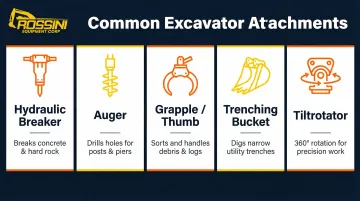
Before selecting a manufacturer, verify that compatible attachments are available for your intended applications — not every brand supports third-party tooling equally well.
Total cost of ownership goes beyond the purchase price. Factor in fuel consumption, maintenance intervals, and parts availability for the brands you're considering.
For contractors and property owners who need equipment short- or mid-term, renting from an established local provider like Rossini Equipment Corp. gives you access to well-maintained machines without the upfront investment or maintenance burden. Daily rental rates for mini excavators typically run $225–$575; operator-included rentals range from $70–$100 per hour for compact machines and $120–$150 per hour for medium excavators.
Conclusion
Selecting the right excavator comes down to matching the manufacturer's strengths — model range, technology, dealer access, and total cost — to the specific demands of the job, not simply choosing the most recognized brand name. A Volvo electric excavator makes sense for urban projects with noise restrictions. A Caterpillar machine with strong local dealer support minimizes downtime on remote sites. A Bobcat compact excavator fits through residential gates.
For contractors, builders, and property owners in Sullivan County, Orange County, and the Hudson Valley region, consult with local equipment professionals before committing to a rental or purchase decision. The right guidance ensures the machine you get is job-ready and appropriately sized for your specific site conditions and project requirements.
Hudson Valley contractors and property owners can turn to Rossini Equipment Corp. for flexible daily, weekly, and monthly excavator rentals — with or without an experienced operator — backed by over 60 years of construction industry knowledge. Reach them at (845) 794-1066 or office@rossiniequipmentcorp.com.
Frequently Asked Questions
What is an excavator company?
An excavator company can refer to either a manufacturer that builds excavators (like Caterpillar or Komatsu) or a company that provides excavation services and equipment rentals using those machines. Manufacturers focus on engineering and production, while rental and service companies maintain fleets and deploy equipment to job sites.
What's the hourly rate for a mini excavator?
Mini excavator rental rates vary by region, machine size, and whether an operator is included. Bare machine rentals typically cost $225–$575 daily, $700–$1,550 weekly, or $1,800–$3,675 monthly. Operator-included rentals run $70–$100 per hour for compact units, so no separate operator is needed.
What size excavator for digging foundations?
Foundation excavation typically requires a mid-size excavator in the 10–30 ton range with a digging depth of at least 14–18 feet. Size depends on foundation depth, soil conditions, and site access — compact units under 10 tons handle shallow residential work, while larger machines suit deep basements or commercial builds.
Which excavator brand is the most reliable?
Caterpillar, Komatsu, and John Deere consistently rank among the most reliable brands in North American contractor surveys, with Volvo and Kubota also scoring highly for long-term value and dealer support. That said, reliability depends heavily on maintenance history — a well-serviced machine from any major brand will outperform a neglected one.
What is the difference between a mini excavator and a standard excavator?
Mini excavators typically weigh under 6 tons and are designed for confined, small-scale work like landscaping or utility trenching. Standard excavators are larger, more powerful, and suited to foundation work, site grading, and heavy earthmoving. Mini excavators offer maneuverability in tight spaces, while standard excavators deliver greater digging depth and lifting capacity.
How do I choose the right excavator for my project?
Start with required digging depth, site access constraints, attachment needs, and project duration. Match machine size to job scope: mini excavators for residential and utility work, mid-size for foundations and site prep, large crawlers for major earthmoving. A local equipment provider familiar with your region's soil conditions — like Rossini Equipment Corp in Sullivan County, NY — can help match the right machine to your specific job.